
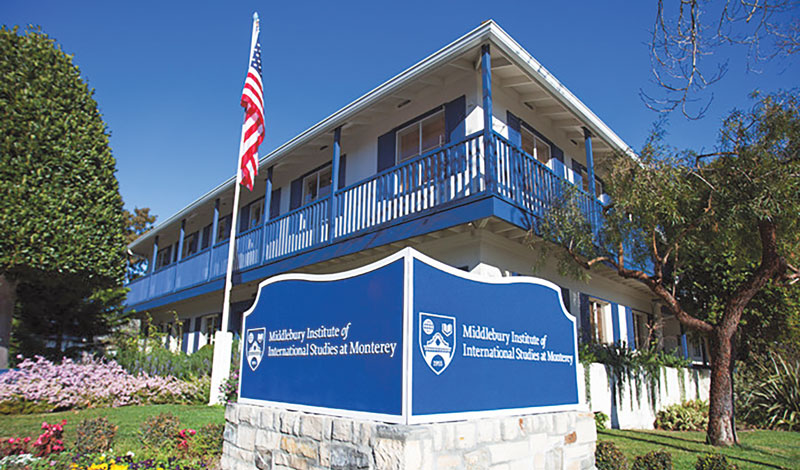
Nearly five decades apart, two institutions of higher learning were founded with the same conviction—that education can help move the world toward peace and intercultural understanding.
The Monterey Institute of International Studies (MIIS) began in 1955 to bridge nations through the study of language and culture. Soka University of America (SUA) opened its Aliso Viejo campus in 2001 with a mission to foster global citizens committed to living contributive lives. Now that SUA has acquired the Monterey campus, as SUA President Ed Feasel announced on Aug. 19, the two institutions’ educational traditions are coming together.
SUA’s second campus will continue select graduate programs previously offered by the Middlebury Institute of International Studies under the new name Monterey Institute of International Studies at Soka University of America. Classes are expected to begin in fall 2027.
“Our university founder, Daisaku Ikeda, believed that education should empower students to become bridge builders, peacemakers and leaders of a global society,” Feasel said, noting that the Monterey institute has pursued similar transformative education for seven decades.
Founding Visions
Daisaku Ikeda founded SUA to advance an approach to education that develops character, fosters love for humanity and empowers students to contribute to society.
Gaspard Etienne Weiss envisioned an education that would foster international understanding through immersive language and cultural study. In 1955, the Monterey Institute of Foreign Studies welcomed its first students. By 1958, it offered five languages and later became the first U.S. school to train professional interpreters and translators for the United Nations and other global organizations. In 1979, the school became the Monterey Institute of International Studies, reflecting its broader global mission.
Fumihiko Tominaga, a graduate of both SUA and MIIS, sees striking similarities between the institutions: Both emphasize diversity, international engagement, community, peace and dialogue. “There was a similar sense that learning was not simply about acquiring knowledge,” Tominaga said, “but also about learning from one another and developing the perspectives and relationships needed to engage with the wider world.”
Where Purpose Meets Practice
Feasel has distilled this juncture’s significance as the point where the “why” and “how” converge. Here, SUA’s mission of fostering global citizens meets MIIS’s program of practical training.
Max Lau, another graduate of both institutions, experienced that progression firsthand. After studying dialogue and conflict resolution at SUA, he further developed those skills at MIIS, including representing Mexico in a semester-long Nuclear Non-Proliferation Treaty simulation class.
Tominaga likewise transformed his SUA experience into professional preparation at MIIS. Today, he works as an environmental and social specialist at the Green Climate Fund, helping developing countries respond to climate change.
As SUA prepares for classes in Monterey in fall 2027, the two traditions come together around a shared conviction: Education should cultivate the values and practical skills needed to address global challenges. “Having experienced both institutions firsthand,” Lau said, “I see this continuation not as the joining of two separate missions but as the natural extension of one.”
For further information, please click here to visit SUA’s official website.
You are reading {{ meterCount }} of {{ meterMax }} free premium articles