
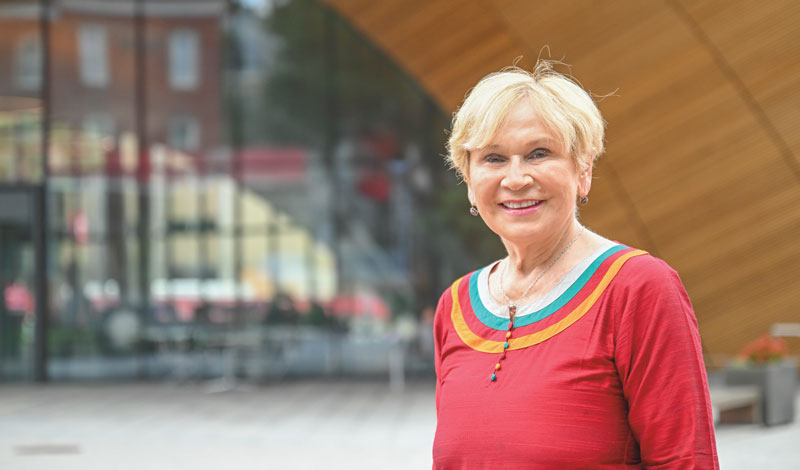
by Dawn Lomden
Philadelphia
It was near midnight when I landed at last in Chengdu, China, well past hospital visiting hours. Still, to my husband’s student, who picked me up at the airport, I said, “We’re going to see him right now.”
The sight of Peter intubated, sedated, shocked me. We’d spoken just hours ago, before my connecting flight. He had not told me they were putting him under, only that he loved me, and the next three days were critical.
By his side, I began fiercely chanting Nam-myoho-renge-kyo, as I had nearly every waking hour since I’d gotten the news that he’d been diagnosed with a severe form of pneumonia. As I did, passages from Nichiren Daishonin’s writings came streaming to mind, and my fear gave way to courage.
Three weeks earlier, Peter had left for what was supposed to be a monthlong lecture tour of China—a short trip for him, whose “retirement” included yearly excursions abroad to teach. Yet the night before he left, he hadn’t slept, anxious, he said, about the flight. Folding and unfolding his hands as he spoke—a familiar habit of his—he acknowledged it was odd that he should feel this way when he flew thousands of miles a year.
I stayed by his side for the next 11 days, chanting and conferring with the doctors. Daimoku gave me the strength to keep it together, for my own sake and for Peter’s kids back home. Every morning, we got on a call with the doctors to talk through options for treatment. Hard as it was, it was hardest on them, half a world away from their father.
On what would’ve been Peter’s last scheduled day in the country, it became clear that his time was approaching. Chanting by his ear as his breathing slowed, I prayed for the eternal happiness of my husband, my friend.
The coming weeks were a blur—we held a Buddhist memorial here in Philly, officiated by the same friend who’d officiated our wedding. The memorial was a beautiful, powerful one that brought us all closer together. It was an extraordinary feat for our family, still shaken by loss, and one I’ll never forget. So it was all the more shocking when, just a few months later, our family began unraveling over my husband’s estate. Most of it had been rightfully willed to his children, but he’d left me a stipend to cover his half of our household expenses. Peter made this arrangement long ago, yet now it was a point of contention. I found myself chanting, anxious and hurt, wondering why it was so hard to simply honor his last wishes.
I was still hurting nine months later when we gathered at last, in September, to sign the updated trust. As the notary walked us from one dotted line to another, the kids and I barely spoke. In fact, they hardly paid me a glance, chatting like I wasn’t there. I felt no relief—only pain as I left, which I carried home with me.
It occurred to me that I’d been dwelling on this particular wish of my husband’s while losing sight of the most important one of all. Family had been everything to Peter. If I were to be a beacon for him, I’d need to become one for the people he loved most. Something had to shift—and not in anyone else. Something had to shift in me.
That month, I came across guidance from Ikeda Sensei that I immediately reread, feeling as though I were being addressed directly:
Our parents, partners, siblings and children are all part of the environment we find ourselves in; we are bound to them through our karmic ties. …
What are we to do, then? Instead of blaming our relationship problems on others, we can decide to change ourselves. (The New Human Revolution, vol. 26, p. 204)
I would not wait around hoping for something to give; I would become someone everyone could lean on.
There’s a young woman in my SGI organization whose mother I’ve known since we were young. The daughter, who I’d tried to connect with in the past, was now a senior in high school. Seeing her juggling many responsibilities, I determined to support her in Sensei’s stead. I began to connect however I could, grabbing coffee or running an errand together. Soon we were chanting about what her challenges were—applying to college, school life, home life and work. And I saw her begin to believe in herself and take action to win.
When I had been just a bit older than her, I met the person who introduced me to this Buddhism. She was an older woman—my boss—who believed in me and showed by example how to tackle challenges with optimism. I was struggling deeply at the time, having just left an extremely toxic relationship. I’d tried to take my life more than once, but through Buddhist practice began to deeply respect myself.
Now, I began praying to show this young woman how a disciple of Sensei responds to difficulty with joy. Of course, this prayer shifted my perspective, and I began to notice things I hadn’t before.
The following month, I attended a choral performance in which my granddaughter, Violet, would sing. Craning to pick her out among all the kids lined up in their matching robes, I couldn’t find her—a big concert piano blocked half of them from view. And then, by chance, beneath the piano, I spotted her hands, folded in a familiar way. It was exactly how Peter often held his hands—I leaned over to confirm what I already knew. It was Violet, all right, with a serious face, waiting for her cue from the conductor. I had never noticed how much she resembled her grandfather—actually, I caught my breath.
I texted Violet’s mom that evening, and she texted right back. She was aware of this too, their strong resemblance. From here, things opened up between me and all of Peter’s children. I began to invite them on day trips to the zoo or the movies, and we grew closer again.
It’s not that everything is all rainbows and songbirds or that grief no longer catches me by surprise. What I can say is that the prayer to change myself has opened paths I didn’t know were there. Peter’s final wishes were not only written in ink; they live in the family he loved. I have learned that daimoku, when backed by a vow, has no bounds and can light a way forward, bright enough to envelop us all.
You are reading {{ meterCount }} of {{ meterMax }} free premium articles