
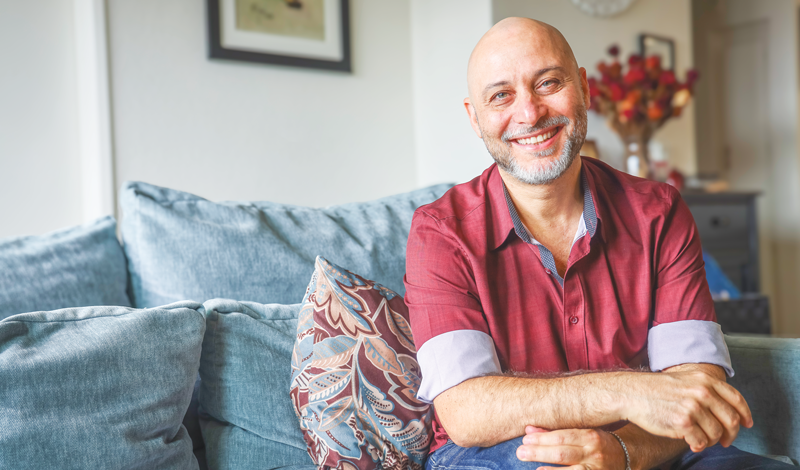
by Giuseppe Russo
Los Angeles
“Naomi Campbell!” I cried, slapping my friend too hard on the back, turning his smile into a wince. He’d landed his biggest contract yet, with a supermodel. “Che fortuna!” I muttered, gritting my teeth—What fortune!
A Latin motto sums up my view back then: mors tua, vita mea—your loss is my gain. It’s brutal, but so is the acting industry, where it means: That’s just how it is; nothing personal.
At times, I was on the winning side, at others, the losing one. I knew which I preferred. Seven years earlier, in 2001, I’d begun chanting, introduced to the SGI by my agent, and kept chanting after seeing a windfall of breakthrough contacts.
Recently, though, I’d hit a dry patch, while my friend had struck gold. Receiving updates on his endless successes, I tried to smile. But inwardly, winced in pain.
I knew envy well and believed it came with the trade. But never had I felt it so strongly for a friend. After seven years of practicing Buddhism, I realized just how unnatural a feeling this was. I sat in front of the Gohonzon and chanted to feel what I seemed unable to feel for my friend.
As I kept chanting, something changed. To use an acting phrase, I slipped into his skin, feeling as happy for him as though his victories were my own—happier, in fact, since my own victories were often clouded by anxiety. It was the first time in years I’d felt such joy. My friend had won, and I hadn’t lost—something I hadn’t thought possible. In that moment, I won over myself, a victory I’d repeat throughout my Buddhist practice.
In 2009, a devastating earthquake leveled whole neighborhoods in L’Aquila, central Italy. Piling into a car, me and my friends in faith set out to perform for those who’d lost everything. Not all of us were actors, but that day, we were, performing comedies to lift people’s spirits. Between encampments, we chanted, not for ourselves, but for the smiles of the people of L’Aquila, which reminded me why I’d pursued acting in the first place. Remembering this has been a lifelong challenge, one that became particularly difficult four years later, when I moved to Los Angeles with little money and a dream of landing a role in film.
In the US, I chanted and attended SGI activities inconsistently. By my third, potentially last, year in the States, I was acting to survive, with no room left for love of the craft. When a senior in faith asked if I’d like to know how to get my visa, I keyed in, expecting some insider’s tip.
“Do gongyo every day for a year,” he said. I decided to give it my all.
In 2016, my mother passed away in Italy, without me by her side, my greatest fear when I’d left for the States. My Buddhist practice helped me to not only face this most painful loss, but to live on with a creative, unbroken spirit. That year, in fact, was also a year of major breakthroughs, beginning with the blossoming of a new relationship with my now-wife, Enisha, and ending with the approval of my Green Card, which came on Christmas Eve.
I never forgot the prayer that brought me to LA in the first place: to land a movie role. It seemed to be coming true at last, when in 2019, I booked a part in an independent film destined for streaming. My role was small—the villain’s right-hand man—but my interactions with the director made my character more visible. As my role grew, so too did old anxieties, and I obsessively compared my role to others. By the shoot’s end, my character had become one of the main roles—my big break had finally come. I might have been a little less certain had I remembered the following from my mentor, Ikeda Sensei, on the relationship between our motives and our results.
Of two people making comparable efforts, the results will differ greatly if one person is motivated by a value that transcends the self—good, beauty, the wellbeing of others—while the other is motivated by ego. (Unlocking the Mysteries of Life and Death, p. 117)
The shoot wrapped, and then the industry came to a halt. For over two years during the pandemic, there was no word of the movie’s fate. I worked long hours at a restaurant, waiting and hoping until, in 2022, an email notified me of the film’s release on YouTube.
YouTube? A flop—me and the movie.
That year, I took on more responsibilities in the SGI—chapter men’s leadership and zone men’s future division leadership. In this second role, I worked with kids, and it was amazing for me. I tried to approach them as Sensei would, as equals. They responded by sharing their ideas, passions and opinions. They reminded me of something I’d drifted from—my own humanity, untouched by age, career or status.
In May 2023, we put on a talent show. Some sang, one played banjo, and another danced. Watching their pure joy raised an essential question for me: Why am I an artist? I had to admit, I’d lost sight of the answer.
That year, I landed another movie role, which suited me perfectly. This time, I took it as an opportunity to do my human revolution. Usually, I’d chant single-mindedly for such a role and not much else. But this time, two friends were auditioning for the same film and I chanted for all of us to win.
We prepared for the audition together, reading each other’s lines. When each of us got a part, we were overjoyed. The day before filming, union issues shut down production, and I chanted for it to resume and for us to be paid fairly. Weeks later, issues cleared, and I shot my scenes. But before my friends had filmed their scenes, the movie was blocked again. We heard nothing for over a year.
Once again, it seemed I’d shot a movie destined for nowhere, with my friends stranded too. Though deeply disappointed, I kept chanting with the same goals: that all cast and crew be paid and the movie released. This past July, I received the news the movie had wrapped and would be released on a major streaming platform. It came with an invitation to my first Hollywood premiere and red carpet. I found that while neither of my friends had filmed, both had been paid—something of a miracle in the industry of the time. This experience has taught me how to pray about my dreams—not out of ego or fear, but with faith that includes the dreams of others. Together, we advance and smiling, call out: What fortune! What fortune!
You are reading {{ meterCount }} of {{ meterMax }} free premium articles