
The following is from the July 2026 issue of the Daibyakurenge, the Soka Gakkai’s monthly study journal.
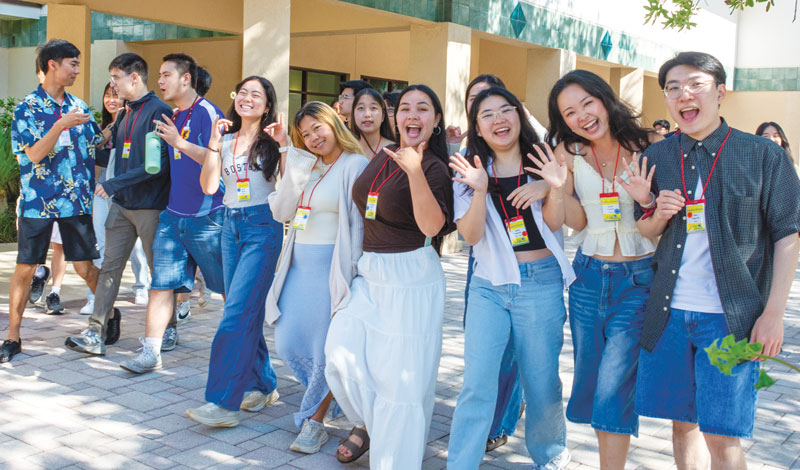
Summer has arrived, the time for young people to strive energetically with the sun of enthusiasm burning brightly in their hearts. In Japan, the young men’s division will hold a magnificent nationwide meeting during July to celebrate its 75th anniversary, while younger members of the women’s division will be attending lively “Kayo College” gatherings across the country.
Ikeda Sensei loved and trusted young people and devoted himself to personally fostering and training them. For countless young men, membership of the Soka Group and Gajokai[1] has been the foundation of the mentor and disciple relationship. In Japan, the traditional functions of both these groups will be terminated this month,[2] and a new structure will be created to inherit and carry on their spirit as we look to the future. The history of the shared struggle of mentor and disciple will remain imperishable. The Fuji Fife and Drum Corps, meanwhile, is celebrating its 70th anniversary this month, “angels of peace” nurtured by Sensei from his time as the youth division chief of staff.
The model for all young people is and always will be Sensei’s own efforts as a youth. The remarkable achievements of the Osaka Campaign under his leadership, which astonished observers of the time described as “making the impossible possible,” still shine as a golden record 70 years later.[3]
Twenty-eight years old at the time, the young Daisaku Ikeda devoted himself tirelessly to personal guidance and home visits, taking his place at the front line of propagation. The people of Kansai were able to witness the nobility of the spirit of mentor and disciple through the way he embodied the words of Nichiren Daishonin: “In a single moment of life, we exhaust the pains and trials of millions of kalpas” (The Record of the Orally Transmitted Teachings, p. 214). They were able to experience the greatness of Buddhist faith and practice, and rose up to fulfill their mission as Bodhisattvas of the Earth.
On July 18, 1976, the “Song of Human Revolution” was completed, marking the anniversary of the Osaka Rally of 1957, the origin of the “invincible Kansai spirit.” At the time, the initial signs of the first priesthood incident[4] were beginning to emerge, and Sensei made time in his demanding schedule to revise and polish the lyrics and compose the melody—all to encourage the sincere members. When the song was finished, he called Soka Gakkai representatives across the country, playing them a recording of it over the telephone. As the new song spread throughout the nation, it inspired members to joyfully share the truth of the Soka Gakkai, creating a history of triumphant victory.
The night he completed the song, Sensei inscribed the final version of its lyrics with the names of the first three Soka Gakkai presidents at the end. The lyrics “Take your stand, and I will take mine, too” were a loving call to all his disciples to live their lives true to the spirit of the first three presidents. In the same way, in his transcription of the lyrics of the Soka Gakkai song “Youth with a Noble Vow,” he wrote the annotation “kimi” (meaning “you” in English) alongside the words “youth” and “successors” as a way to personalize and individualize the message.
Now is the time for each of us to become the driving force for kosen-rufu, advancing along the path of our vow in our own unique way.
July 10, 2026 World Tribune, p. 8
References
- The Soka Group and Gajokai are behind-the-scenes training groups created by Ikeda Sensei to foster young leaders who possess both the spirit and ability to serve humanity. ↩︎
- This organizational restructuring applies only to the Soka Gakkai in Japan. The current functions and activities of the Soka Group and Gajokai in SGI-USA remain unchanged. ↩︎
- Osaka Campaign: In May 1956, the Kansai members, uniting around a young Daisaku Ikeda, who had been dispatched by second Soka Gakkai President Josei Toda to support them, introduced 11,111 households to the practice of Nichiren Buddhism. In elections held two months later, the Soka Gakkai–backed candidate in Kansai won a seat in the Upper House, an accomplishment that was thought all but impossible at the time. ↩︎
- On April 24, 1979, Daisaku Ikeda stepped down as third Soka Gakkai president to shield the members from the perverse machinations of the Nichiren Shoshu priesthood, which had colluded with corrupt former Soka Gakkai leaders to wrest control of the lay organization. While Ikeda Sensei’s activities in Japan continued to be curtailed by the priesthood, he turned his focus to opening the path of worldwide kosen-rufu. ↩︎
You are reading {{ meterCount }} of {{ meterMax }} free premium articles