
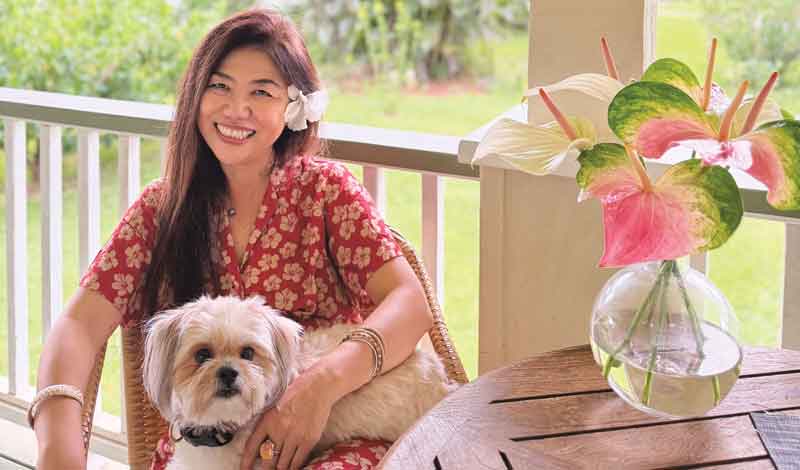
by Akiko Hosaka
Kauai, Hawaii
I don’t know what it was that gave me away, but somehow my neighbor knew that I was the neighborhood Buddhist.
“I heard we had one,” she called out last year while I was walking my dog. “Is it true? Is it you?”
There was a time when the notion was unimaginable—not only to me but to all my friends. “No. 1 Christian,” they called me, but that was 20 years ago—I’ve long forgotten to feel surprised to hear myself called Buddhist.
“I’ve studied lots of sutras,” my neighbor went on, “but never the Lotus! I’d like to!”
“Well, come see!” I called back. Like most people I meet these days, I found her open and eager to try. Not like me at all, who’d been dragged—or better said, shocked—into giving Buddhism a go.
In 2005, I’d woken to my husband’s back sitting stooped at the edge of the bed. Good morning, I might have said, but honestly, I don’t remember. Only what he said back, heavily, abruptly: “I want a divorce.” Those words, for me, came out-of-the-blue and sent me absolutely reeling.
My friend came right away, traveling all the way from Japan. For one whole month, she stayed with me, while I just about lost my mind. She tried everything: encouragements, comforts, appeals to my senses. Above all, she tried to get me to chant Nam-myoho-renge-kyo, but I refused and would not budge. I would not until and unless I got one simple guarantee.
“Will this save my marriage?” I asked. But it was the one promise she would not make.
“I guarantee,” she said again and again, “that this will help you become happy.”
I did not believe, nor even understand what that meant and yet, at the end of her monthlong stay, I decided to receive the Gohonzon. It was not because I believed it would help, but because I had a friend—undeniably, a great friend—who was utterly convinced that it would.
In my first four months of practice, I dove in, chanting more, I think, than I have ever since. But summer followed spring and brought no change—only the same self-pitying thoughts. And yet, one thing was changing, though I would not have admitted it then—I was beginning to hear my own thoughts and realize that each shared something in common: every one of them was about me—my gain, my loss, my wounds, my pain. It was how I’d thought, I realized, my entire life. At the end of that summer, I had the chance to vent to a senior in faith. From my endless complaints, she drew a baffling conclusion.
“Actually,” she said, “you are changing. You just can’t see it yet.” There was one piece missing, she said—one crucial piece of Buddhist practice that I needed to help me break through. This, she said, was shakubuku—the act of sharing Buddhism with others.
I didn’t get it. But I was desperate, remember? I started chanting to find someone to shakubuku right away, someone as desperate as me, who’d be my ticket to a breakthrough—my ticket back, I thought, to my marriage. Looking back, I see what a selfish prayer it was, and also, that it was just about the only prayer for another person I could manage at the time.
In any case, I gave it a go and met someone suffering. He had seasonal depression that came every September, the month his father had died. But from the start he sensed he’d found something to help, saying after chanting: “This works.” September came and he felt alright and that November he received the Gohonzon. Watching this person transform his suffering, I received something as well: if not yet happiness, then at least some sanity—a state of mind that came close to normal. At the very least, I was no longer trapped in endless blame and self-pity. I could accept that I wouldn’t find happiness in a marriage wanted only by me. Chanting and sharing Buddhism, I began to let go and to feel, almost despite myself, lighter, surer, more focused. I began to understand the promise my friend had made, and why she’d gone to such lengths to make it. The more I shared the practice, the happier I felt and the more I asked myself, What can I do to bring joy to others?
In 2010, I moved in with Dan, the person who has become my life partner—someone, in fact, who I’d introduced to Buddhism. In 2015, he purchased a cottage on a plot of land, and soon after expanded the home to serve as a gathering place for the members. Over the years, countless joyful SGI meetings have been held in our home. But when the COVID-19 pandemic struck, community life across the island died down.
Now, I’m someone who can spend huge amounts of time alone and enjoy every minute, but even I began to feel the pangs of missing gathering with friends. When the pandemic restrictions lifted, I determined to go the extra mile to create lasting change on Kauai. I opened my home to host free jewelry-making classes (the girls bring little treasures from the shore—seashells or sea glass). The chapter women’s leader here had just revamped her hula group, and I wanted to team up with her to spread Buddhism. It’s been the most incredible thing.
Naturally, Buddhism comes up—surrounded by nature, at ease with each other, ladies open up about this and that—whatever they’re challenging in life. I just say, “Hey, I’m Buddhist, come over!” and we chant and talk and break through. Kauai Chapter has three districts, and, this year, seven youth have joined Kapa‘a District alone. Dan and I host their monthly meetings at our home. We had 43 in attendance at the November discussion meeting, with everyone eagerly bringing friends.
“I love your meetings!” my neighbor told me this year. “The people, the conversation, the chanting—so wonderful!” She’s a studious one, reading everything she gets her hands on. She received the Gohonzon in September, having found a treasure that enriches her life. We’re the neighborhood Buddhists, her and I, but not the only ones. A treasure kept to yourself is no treasure at all, but shared with others, shines bright. My greatest treasures today are my friends in faith, who are mine, and me theirs, for life.
You are reading {{ meterCount }} of {{ meterMax }} free premium articles