
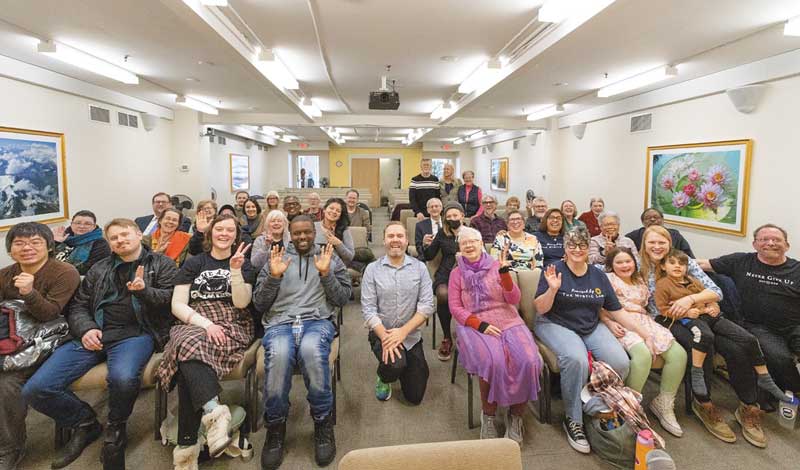
Amid rising tensions in Minneapolis, five Minneapolis-area chapters chose courage—uniting in prayer and action to shift the atmosphere of their city. The World Tribune sat down with the Minnesota Region Women’s Leader Ivett Lorenzano, Men’s Leader Tom Reid and Young Women’s Leader Ally Appelbaum to discuss how uniting together helped build bonds of trust and stabilize their community.
World Tribune: Thank you all for talking with us. Between Jan. 15–25, during your chapter kickoff meetings, tensions were high across Minneapolis. What was the atmosphere like, and how did you feel about what was going on at the time?
Ivett Lorenzano: Honestly, there was fear. When violence escalated in our area—including the tragic shootings—it shook us deeply. Many members were afraid to leave their homes. Some asked if we should move meetings to Zoom. I personally had moments of panic, wondering whether it was safe to drive at night.

But only days earlier, I went to a Florida Nature and Culture Center conference where the theme of courage shared during the presentations stayed with me. I knew that as a leader and a member of this community, I had to raise my life condition first. I couldn’t let fear dictate our SGI activities, especially during such a critical season of our chapter kickoff meetings.

Tom Reid: That’s true. We had been monitoring community tension even before mid-January. When the violence intensified, it became immediate for everyone. We had just wrapped up a region team meeting the night of one of the shootings, and I remember thinking, What is happening in our city? But that meeting also anchored us—we reminded one another why we do this work for kosen-rufu and to stay committed to serving the members with calm determination.

Ally Appelbaum: The fear was felt across all five chapters of our region around the Twin Cities—Minneapolis, Greater Northwest Minneapolis, Southwest Twin Cities, Northern Saint Paul and Saint Paul East. Immigrant communities were particularly affected. Yet each chapter decided to proceed with its kickoff meeting. That collective resolve really set the tone.
WT: How did you see the members’ attitudes transform amid these surrounding events?
Ally: The two shootings that rattled the community occurred within a mile of Powderhorn Lake District. Rather than withdraw, the district young women’s leader began knocking on neighbors’ doors, introducing herself and inviting conversations. They brought four guests to their district meeting—the largest attendance that area had seen in years—and the next month brought four more. That kind of proactive engagement came straight out of the Buddhist practice and study they were applying.
Tom: I remember telling people, “Follow the youth.” And they did. At one of the kickoffs, a district young men’s leader shared an experience about confronting fear in his own life, and a young women’s leader tied her study directly to overcoming a difficult past. Everyone was inspired by their courage.
Ivett: We saw people win over fear in real time. Even with last-minute cancellations and external anxiety, members challenged themselves. Members in one chapter battled uncertainty right up until the meeting; by the time they gathered, there was palpable joy and relief. It was transformative to watch.
WT: That’s great. In our Buddhist practice, we often discuss the concept of the “oneness of life and its environment.” How have your SGI activities during this time influenced the broader atmosphere in the city?
Tom: I truly believe they made a difference. When we chant for the peace of the land and then take courageous action, it affects the environment. In the weeks following those kickoff meetings, there was a noticeable de-escalation in the area. The visible intensity that had defined those earlier days began to subside.
Now, we can’t claim we control every external factor. But what I do believe is that when we raise our collective life condition and expand the forces of the Buddha, we create conditions for tension to ease. We saw that happen.
Ivett: Yes. It felt like the city exhaled. Instead of isolation increasing, connection increased. As the visible pressure decreased, what rose up was our common humanity.
Ally: When one person stands up with hope, it spreads. When five chapters stand up together, that ripple widens. And when an entire region unites in prayer for the peace of the land, you begin to see shifts—not just inside meeting rooms, but across neighborhoods.
WT: What is your vision moving forward?
Ivett: I envision our Buddhist center filled with young people discovering their dignity.
Tom: When we chant for the peace of the land and keep doing our human revolution, things begin to shift—you see protective forces rise up and neighbors help neighbors. So my vision is to stay steady, day by day, because every prayer and every effort to encourage someone contributes to securing the peace of the land.
Ally: My vision is that we raise a generation of youth who are unshakable in that awareness—young people who know they are valuable, who feel empowered to act and who take responsibility for creating peace in their own communities. If we can help even one person awaken to that kind of life state, it ripples outward—into families, workplaces and neighborhoods.
I want Minnesota to be a place known for courageous youth who stand up in difficult times and transform their environment through their own human revolution.
March 6, 2026 World Tribune, p. 11
You are reading {{ meterCount }} of {{ meterMax }} free premium articles