

Living Buddhism: Krithi, thank you for speaking with us today. You experienced, early on, more change than most do in a lifetime. Can you tell us about the events that led your family to practicing Buddhism?
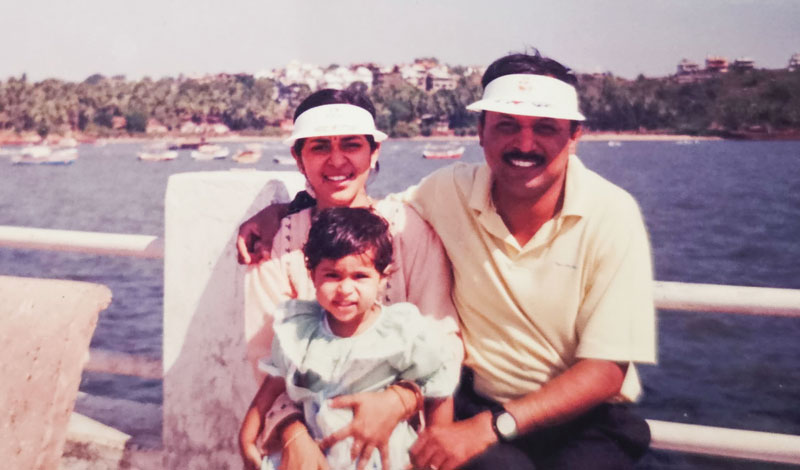
Krithi Byadgi: That’s true, my childhood saw many changes, all sparked by one big change—one major loss that came before the rest. When I was 4, my father passed away, unexpectedly.
You were living in southern India at the time?
Krithi: Yes, in Bangalore, just north of where I was born. Until then, we were happy and well-off—my mother, my father and me. But culturally, in India, a family without a father is seen as incomplete, and my mother came under enormous social pressure to remarry. A few years later, she did. In 2000, we moved in with my new stepfather, to his residence in the San Francisco Bay Area, where we were for all the world no different from our neighbors—a well-off, happy family.
But there were differences.
Krithi: Many—though I tried to hide every one. Be it my accent or our food, I went to great lengths to hide them and fit in. There was another thing too, something my mother and I understood more clearly by the day: My stepfather was an abusive person.
That’s awful! How did that affect you?
Krithi: What’s really awful is how you learn to hide the abuse—to wear a happy face no matter what you feel inside. For seven years, we lived in fear, until one day, in the middle of eighth grade, my mom came into my room and whispered, “We’re leaving.”
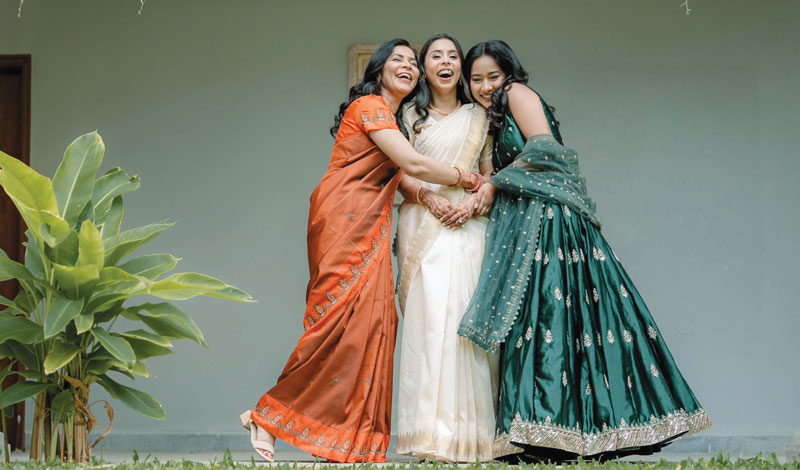
With my baby sister strapped in the backseat beside me, talking happily to herself, I poked my head out the car window and let the sun and wind fall on my face, thinking, astonished: We’re leaving. We’re actually leaving.
What then?
Krithi: We ended up in San Diego, where my mother filed a police report, then sent me to stay with my grandparents in India, while she and my sister stayed at women’s shelters and with friends. This situation was unchanged when I returned later that year. But my mother, I saw right away, was different. She’d encountered Nichiren Buddhism.
The difference was clear.
Krithi: She seemed less afraid, more confident. Her change was what drew me to try chanting Nam-myoho-renge-kyo. For me too, the results were clear.
Such as?
Krithi: Within a year, we’d moved into our own place in the Bay Area—nothing fancy, just a cramped, prefab guest house tucked behind a much larger, statelier house. Nonetheless, it gave us a sense of control and stability we hadn’t known since coming to America. After more than a year between shelters and friends, we saw solid proof that prayers could be answered.
Even then, I was ashamed of our circumstances, comparing them constantly with my peers, from whom I hid our struggles. If friends wanted to go out for lunch, movies or shopping, I’d steal money from my mom’s purse. I felt trapped between worlds—trying desperately to maintain this illusion that I was OK, no different from the rest.
That sounds exhausting. Was there anywhere you felt otherwise?
Krithi: Yes, at discussion meetings. There, I felt what I hadn’t felt anywhere else: safe to simply be. I opened up with the young women’s leaders in particular.
Tell us about them.
Krithi: They were the first friends to really know me. They knew where I really lived—not in the big house out front, but in the tiny unit behind it. They’d come to talk or take me out for ice cream. We’d talk about whatever was on our minds—problems, goals, whatever. They treated me, and I trusted them, as a sister. At 16, I was learning what it was to feel comfortable to be myself.
Something else important happened at 16—can you talk about that?
Krithi: Sure. That year, I testified against my stepfather in court. The week of the trial, the lawyer took me to the courtroom and showed me where he would sit, where I would and, lastly, where the judge would preside. I felt empowered by this. I felt that this was a place where the truth was taken seriously. When it was my turn to testify, I told the truth, and my stepfather went to jail. It was major actual proof for me—that we could live our lives without fear.
In 2012, you graduated high school and went on to earn your bachelor’s in political science.
Krithi: Yes. And honestly, I don’t think that this would have been possible without my Soka family. Because, a warm shoulder was hard to find among my peers. I remember once, bouncing back from the flu, asking a classmate to see her notes on the class I’d missed. “No,” she said firmly. Vying fiercely for top-tier college admissions, everyone was seen as competition. The adults were sometimes no more encouraging. Talking through my options with my guidance counselor in my junior year, she threw up her hands and blurted out, “You’re not getting into college.” That plunged me into despair.
I reached out to my sisters in faith, who encouraged me to win over my doubts and carve out a path to victory. Eventually, I was accepted to a school near home, where I made many friends and shared Buddhism with them all.
You’ve had a dream of pursuing a career in law. Where does it come from?
Krithi: My family has a long history in law, and from a young age I wanted to become a lawyer. But it was not until my own courtroom experience at 16 that the feeling really cemented. I wanted to give vulnerable people—women and children, in particular—the same opportunity to advocate for themselves that I’d had. Perhaps for that very reason, I had an almost allergic response to my first Law School Admission Test (LSAT) in 2017.
How do you mean?
Krithi: Migraines, flashbacks, nightmares and exhaustion—the LSATs triggered all kinds of symptoms, later diagnosed as aspects of a post-traumatic stress response.
I’d just graduated college, with nothing to show for it but a part-time job. My best friends from school had all moved away. Failing the LSAT while suffering through depression and anxiety—major PTSD that I did not understand—I came to feel that my life did not matter. To this day, I don’t fully understand what I did next, in December 2017. Suffering deeply, I made an attempt on my life.
What did you do to recover your will to live?
Krithi: Therapy. And Byakuren. And tons of daimoku and shakubuku.
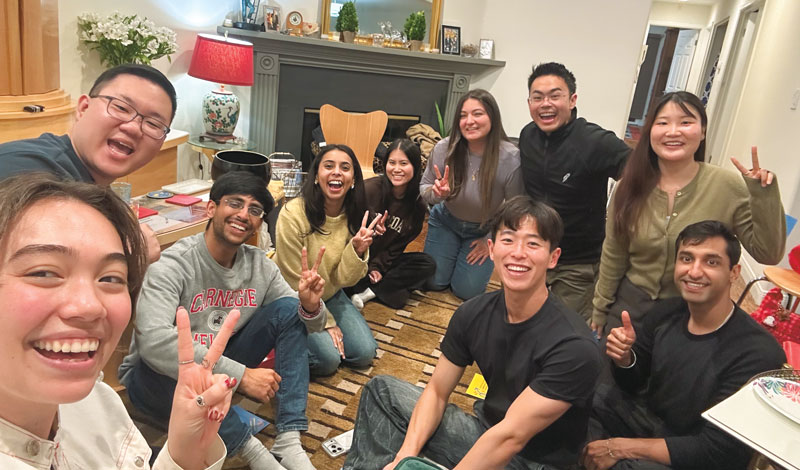
To unpack those for any new readers: Byakuren is a behind-the-scenes training group for young women in the SGI. Daimoku is chanting Nam-myoho-renge-kyo. And shakubuku is discussing Buddhism with others.
Krithi: Right! As I engaged in therapy, I began working through painful things—among them memories I’d suppressed from childhood.
At the start of every Byakuren shift, we chanted together and then shared what we were determined to break through. At first, I did not know for myself what that was. I simply knew that I did not want to feel the way I felt any longer. Every shift, I fought to bring a smile to my face—not to mask my suffering but to give expression to the battle taking place in the depths of my life to transform and win over that suffering. The following year, SGI-USA held the 50,000 Lions of Justice Festival. Two weeks out, at the start of September, I landed full-time work as a legal recruiter. Full of appreciation, I supported the festival behind the scenes, while also bringing three of my friends.
Wonderful! And then?
Krithi: Later that year, I met the man who would become my husband—who was caring and intelligent and kind. Honestly, the relationship felt so good I found myself holding my breath, waiting for something to go wrong. Speaking about this with a friend, she said something that woke me up, that landed like a slap in the face: “It’s obvious,” she said. “You don’t feel you deserve happiness.”
I began chanting in earnest to transform whatever it was in the depths of my life that was holding me back from living a fulfilled and happy life. And I began to realize just how deep was the anger and fear I still harbored from childhood, and how powerfully these still influenced my thoughts and behaviors.
At first, I tried chanting to feel compassion for my stepfather, thinking this was the key to breaking through. But honestly, I just could not bring that feeling out of my life, no matter how hard I tried. It was not until I encountered this guidance from Ikeda Sensei that I began to deeply shift my relationship with my stepfather and what he represented for me:
The Gohonzon is the manifestation of the Buddha endowed with infinite compassion. We should therefore go ahead and chant about our desires, our problems and our aspirations, just as they are. When we’re suffering, feeling sad or experiencing hard times, we should just go to the Gohonzon with an open heart, like an infant who throws himself into the arms of his mother and clings to her. The Gohonzon will “listen” to our every word, so we should chant abundantly as if we are carrying on a conversation, confiding our innermost thoughts. In time, even hellish sufferings will vanish like the morning dew and seem as but a dream. (The New Human Revolution, vol. 11, revised edition, p. 106)
Without trying to feel a particular way, chanting just as I was, I began to feel something I did not expect—appreciation for everything in my life. I was, at this time, meeting with many members of the young women’s division and supporting some of them through painful ordeals. As I did, I found that just listening to them, chanting with them and seeing them move toward victory, step by step, was the most meaningful, privileged experience of my life. I did not have to wait to be a lawyer to help young people feel heard and empowered. I was doing it already. For the first time, I felt appreciation for everything—my stepfather included—that had spurred my life in the direction of Buddhism, in the direction of the person I had become.
Where did this lead you?
Krithi: Toward clarity and happiness.
Since I was old enough to think about it, I’d ruled out the possibility of marriage. It was just not something that I saw for myself. But as I chanted with and supported the youth in my region, I began to wonder whether I was actually afraid of marriage and family life—afraid that I didn’t have what it took.
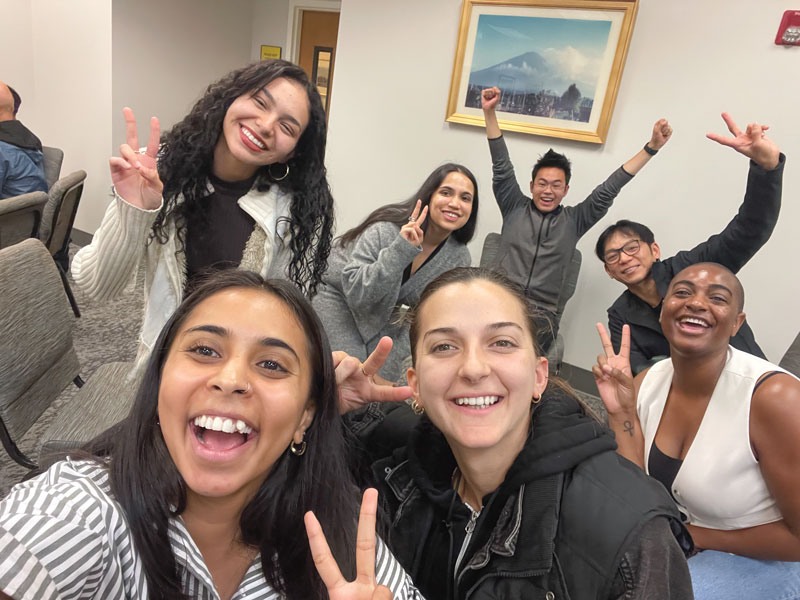
I began chanting in earnest about what I truly wanted: to decide not out of fear but with conviction and joy. Toward this end, I took on greater responsibility in the SGI, striving to support many capable, happy young women and nonbinary youth in San Francisco Ever-Victorious Zone.
What did your partner think of your practice?
Krithi: As we got serious, we reached what was for me a familiar point of tension in past relationships—specifically around my commitments as a leader in the SGI. Previously, whenever a boyfriend told me I was doing too much, I yielded right away, pulling back from my responsibilities, anxious to preserve the relationship. But this time was different. I was different. My Buddhist practice was not merely something I did—it had become a vow, inseparable from me as a person. And I was not going to hide it—especially not from someone I deeply loved.
For the first time, I stated clearly that my Buddhist practice was for life. I wasn’t sure what would come of this, but I was delighted by what did. Trust deepened, and curiosity too. He actually began reading Sensei’s works and joining me to chant. Today, he fully supports my practice, encouraging me when I’m struggling. At our wedding last year, we led gongyo with our families and friends in attendance. With him by my side, I’ve reached a point where I know we can build a harmonious family. In fact, we’re expecting our first child, a boy, in November. And I am so excited!
Congratulations! And what about law?
Krithi: I made major breakthroughs in that too. For two years, I’ve been a legal assistant and am now transitioning into paralegal work. While I haven’t yet passed the LSAT, I’m not afraid of it anymore. I’m determined that this next time, I’ll pass.
What do you want to say to those reading this story?
Krithi: That people can transform even the darkest experience into something beautiful. I never imagined my life could look the way it does. There were times I felt ashamed of everything—my family, my housing, my trauma, my fear. But as a Buddhist, I’ve found a mentor, a community and a sense of my mission. My past is not something that controls me any longer—it’s something I draw on every day, to encourage and empower those around me. Truly, I can say that I am profoundly appreciative for my life and everything in it that has made me who I am.
You are reading {{ meterCount }} of {{ meterMax }} free premium articles