
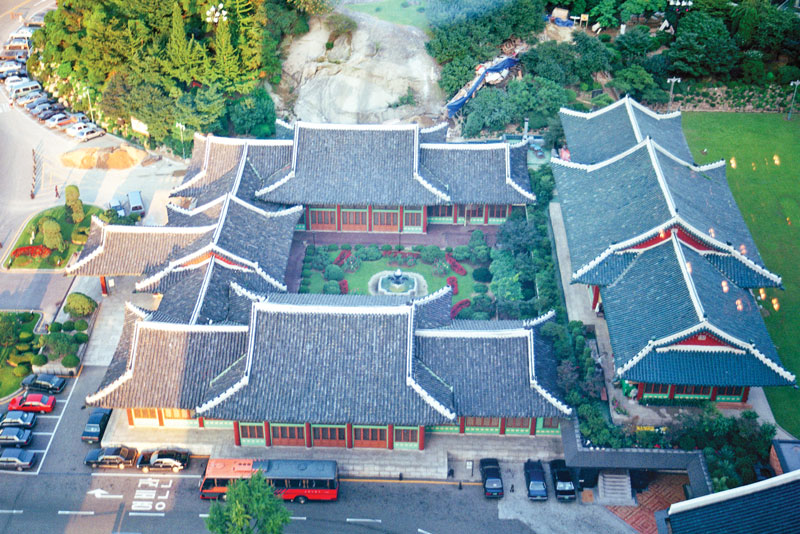
It was my second trip to South Korea, in May 1998, after a period of eight years. White ridges topped the graceful blue-tiled roof—a portrait of gently arching lines. Here in South Korea, amid a beautiful natural setting, I felt I had encountered an indescribable gentleness.
This building, visible from my hotel room window, is called the “Guest House.” Exactly as its name implies, it was once used to greet and entertain special guests of the state. Construction began in 1959, and after two interruptions the entire project, including the stately courtyard and garden, was finally completed in 1967. …
Gazing down at the Guest House from my hotel window, I could see a square-shaped garden in the center of the courtyard. It is traditional in South Korea for such a courtyard garden to take the shape of a square, resembling the Chinese character for mouth; of two adjacent squares, symbolizing the Chinese character for sun; or of three such squares, indicating the character for moon.
A mouth-shaped garden is said to invite good fortune in the form of abundant food for the household. A sun- or moon-shaped garden is said to provide a household with heaven’s energy. In this way, the entire structure communes with the heavens. This is why great pains were taken to align the roof tiles in an exquisite, delicate pattern, even in places that are hidden from view. Culture is also the spirit never to dismiss such honest simplicity.
On the last night of my visit, we were given the use of a room in the Guest House to hold a banquet for representatives of Kyung Hee University and others I wished to thank for their assistance with my visit. On that occasion, I praised Oh Chung Myung, wife of Choue Young Seek, the university’s founder. During the early days of the university, with her baby strapped to her back, she would prepare and serve home-cooked meals for students suffering from financial difficulty and offer them encouragement.
In those days, there were times when the university had a hard time paying teachers’ salaries. One day before payday, Mrs. Oh took her diamond engagement ring to a pawnshop to exchange for much-needed cash. The pawnbroker turned her away, though, claiming that he could not be sure the diamond was real. She walked home alone in the dark in tears. In spite of such hardships, she has lived for the purpose of realizing Dr. Choue’s determination for the creation of a “world of culture.” That is the strength and kindness of this amazing “mother” of Kyung Hee University.
That, I thought, is the heart of the Eastern “country of kindness,” a spirit that also imbues the Guest House. Standing next to her husband, dressed in traditional chogori short-coat and ch’ima skirt, Mrs. Oh looked delightfully charming and unaffected as she listened somewhat bashfully to my tribute to her efforts.
That night, the silver light of a half-moon bathed the blue-tiled roofs of the Guest House.
Adapted from an essay in Our Beautiful Earth: Photos and Essays of My Travels, by Daisaku Ikeda, April 2, 2000, Seikyo Press, Tokyo, Japan.
You are reading {{ meterCount }} of {{ meterMax }} free premium articles