
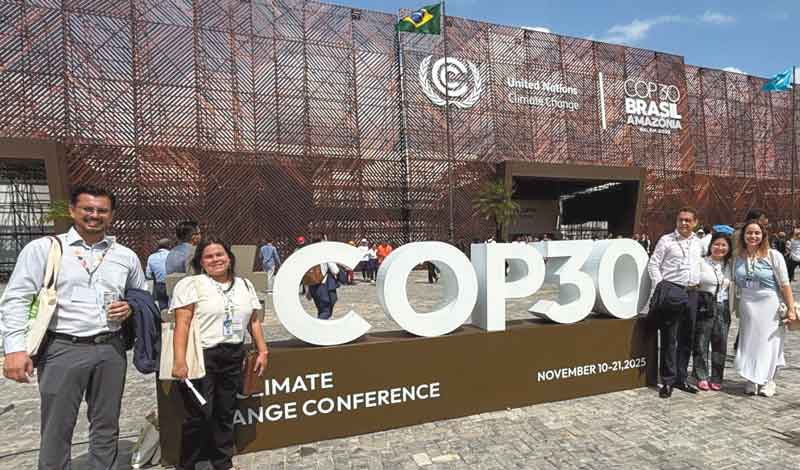
As the world faces two mounting existential threats—the heightened risk of nuclear weapons use and the accelerating climate crisis—the Soka Gakkai International (SGI) is calling for renewed global solidarity and decisive action. With climate impacts intensifying worldwide and the Paris Agreement’s goal of limiting global warming to 1.5 degrees Celsius increasingly in jeopardy, the SGI issued a statement “Mobilizing Global Solidarity to Meet the Challenges of the Climate Crisis” ahead of the 30th U.N. Climate Change Conference (COP30), which opened on Nov. 10, 2025, in Belém, Brazil.
Last year brought record-breaking temperatures, worsening floods and wildfires, rising sea levels and accelerating glacier melt. These developments signal that humanity may be approaching critical thresholds. At the same time, the SGI warns that international cooperation—essential for addressing the climate crisis—is weakening amid geopolitical tensions and economic uncertainty. Such conditions risk fostering resignation and despair, undermining the resolve needed to sustain and strengthen climate action.
Nevertheless, the SGI emphasizes that hope remains possible through collective effort. Advances in renewable energy, now projected by the International Energy Agency to surpass coal as the world’s largest source of electricity by 2026, demonstrate what can be achieved through shared commitment. Brazil’s role as the COP30 host also carries historical significance, recalling the 1992 Earth Summit, where landmark environmental agreements were launched and humanity’s capacity for cross-border cooperation was affirmed.
The SGI highlights its long-standing efforts to raise awareness and promote sustainable solutions, including the global exhibition “Seeds of Hope & Action: Making the SDGs a Reality” and reforestation initiatives in West Africa conducted in partnership with the International Tropical Timber Organization. Building on this experience, the SGI presents two key proposals aimed at strengthening international solidarity.
The first focuses on mobilizing civil society, particularly faith-based organizations, to inspire behavioral change and amplify the voices of those most affected by climate impacts. With more than 80% of the world’s population affiliated with a faith tradition, religious communities are uniquely positioned to foster ethical commitment and human-centered responses. Reflecting SGI President Ikeda’s long-standing perspective, the statement underscores the need to center on the lived suffering of individuals and communities. In his 2020 Peace Proposal, President Ikeda cautioned against relying solely on abstract metrics, stating: “It is important that we attend to the actual suffering of the many individuals that such macroeconomic indices might obscure, and make this central to our efforts to come together in search of solutions.”
The second proposal calls for mainstreaming youth engagement through the establishment of a permanent youth council within the U.N. Framework Convention on Climate Change Secretariat. Young people—who will bear the greatest consequences of today’s decisions—have already played a catalytic role in advancing climate justice, including efforts that led the International Court of Justice to affirm states’ obligations to protect the environment. Embedding youth leadership within international frameworks, the SGI argues, is essential to driving innovative, future-oriented solutions.
Concluding its statement, the SGI urges governments, civil society and individuals to act with courage and solidarity. By uniting grassroots action with stronger institutions that empower youth, the SGI affirms, humanity can protect the lives, dignity and livelihoods of both present and future generations.
—Adapted from sokaglobal.org, the Soka Gakkai’s international website
You are reading {{ meterCount }} of {{ meterMax }} free premium articles