
by Lillian Koizumi
Special to the Tribune
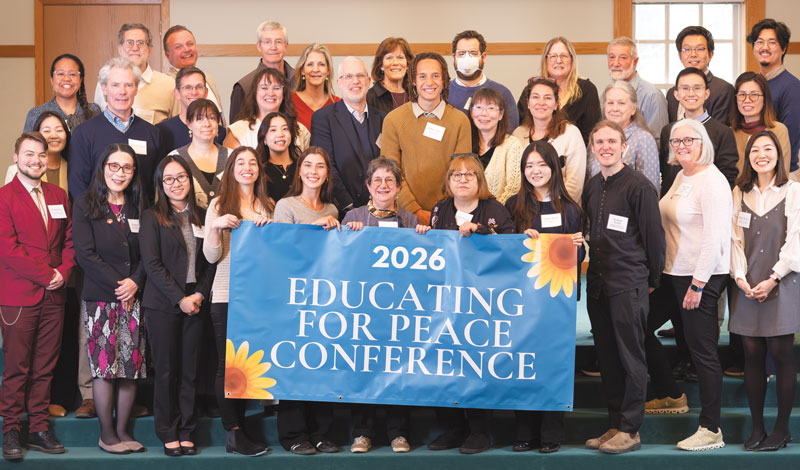
The second annual Educating for Peace Conference was held April 25–26, 2026, at the Ikeda Center for Peace, Learning, and Dialogue. Co-organized with the Soka Institute for Global Solutions at SUA (SIGS), the James Martin Center for Nonproliferation Studies (CNS) at the Middlebury Institute, and EdEthics at the Harvard Graduate School of Education, the conference brought together middle and high school teachers from across the United States to explore effective ways to teach students about the threats and historical legacies of nuclear weapons, to reflect on what it means to educate for peace at this time, and to build a network of teachers committed to nuclear disarmament through youth education.
Keiko Ogura, a Hiroshima atomic bomb survivor, sent a written message to the conference. In it, she spoke about her experience growing up in wartime Japan and witnessing the horrors of the atomic bombing of Hiroshima. She emphasized the importance of disarmament education and our ability “to imagine the pain of others.” She said that though she is no longer young, she has not lost hope: “Because education is hope itself.” She called on the teachers in the room to build the “defenses of peace” in the heart of a single child.
Over the course of two days, conference participants learned from leading thinkers, scholars, and youth activists in the field of nuclear disarmament education, such as Dr. Ira Helfand of the International Campaign to Abolish Nuclear Weapons, Stephen Herzog (CNS & Harvard’s Project on Managing the Atom), curriculum developers from GBH PBS Learning Media, and representatives from Students for Nuclear Disarmament. Through a series of presentations and workshops, the teachers explored the importance of peace education and developed lesson plans that they can bring back to their classrooms and schools. One Boston public school teacher implemented the resources in his class the following week.
In Herzog’s presentation, he examined how nuclear weapons are taught and debated, highlighting the divide between deterrence and disarmament. He urged the educators in the room to engage students critically rather than dismiss opposing views. Ultimately, he advocated for more nuanced education, open dialogue and serious consideration of disarmament as a way to reduce existential global risk.
At the end of the conference, participants reflected on and wrote their commitments to this work. One teacher wrote that he is committed to bringing five teachers to next year’s conference. Another committed to starting a chapter at her school for teachers who are interested. A member from the City of Cambridge Peace Commission also shared her commitment to revive the city’s nuclear disarmament mission.
In their concluding remarks, conference organizers Kevin Maher (Ikeda Center), Tetsushi Ogata (SIGS) and Masako Toki (CNS) expressed their appreciation for all the speakers and teachers. Ogata called on everyone to “envision” together a future without nuclear weapons. Maher invited the teachers to bring their colleagues to next year’s conference and continue growing this network. While acknowledging the lack of disarmament education in the current moment, Toki shared that these two days working with high school teachers, students and like-minded people gave her hope.
You are reading {{ meterCount }} of {{ meterMax }} free premium articles