
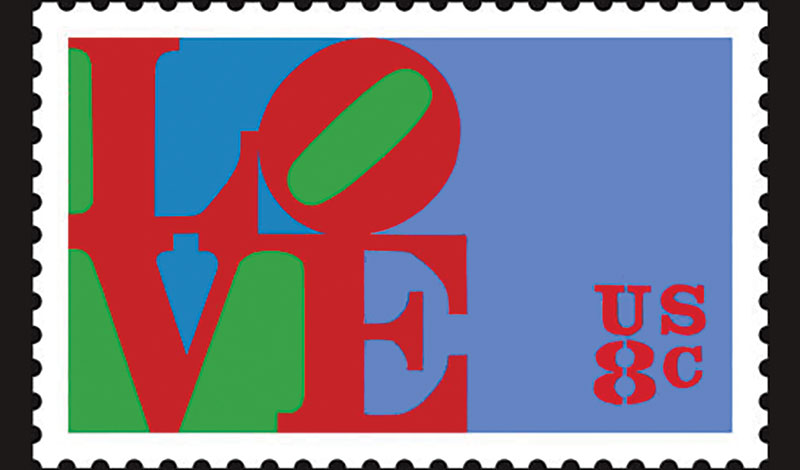
Hug. Love. Amor. Robert Indiana (1928–2018) transformed these letters and words into bold visual compositions. Through his distinctive style, he turned ordinary language into powerful visual statements.
Robert Indiana was born Robert Clark in New Castle, Indiana. He was adopted as an infant and, throughout his childhood, his family moved throughout the Midwest. After graduating from high school at 17 years old, Indiana served in the United States Air Force for three years. He then pursued his passion for art by studying at the School of the Art Institute of Chicago as well as schools in Maine and Scotland. In 1954, he moved to New York City and became involved in Manhattan’s growing art scene.
Living in New York marked a major turning point in Indiana’s career. Surrounded by industrial buildings and abandoned warehouses, he found inspiration in the urban environment. During this period, he began creating artworks featuring simple geometric forms, vibrant colors and meaningful words. After completing his artwork Stavrosis (1958), he adopted the surname “Indiana” as a tribute to the state where he spent much of his childhood.
Indiana developed a unique artistic style that made his work instantly recognizable. Bold compositions combined simplicity with powerful messages, helping the artwork gain attention in galleries and museums across the United States. Indiana’s art reflected a poetic spirit, finding depth and emotion in a single word or symbol.
His famous work, LOVE (1964–70), was originally designed in 1964 and later appeared on a Christmas card for the Museum of Modern Art in 1965. LOVE became an international icon after being displayed at the Stable Gallery in 1966. In 1973, its popularity earned it a place on a United States postage stamp. The colors red, blue and green were inspired by Indiana’s memories of Philips 66 signs against bright blue skies.
Throughout his art career, Indiana made significant contributions to Pop Art by transforming ordinary words and symbols into meaningful works of art. By blending the visual power and meaning of words, he revealed the poetry hidden within everyday language. His innovative use of iconography and color created a legacy that continues to inspire artists and audiences around the world.
—Prepared by the World Tribune staff
June 12, 2026 World Tribune, p. 12
You are reading {{ meterCount }} of {{ meterMax }} free premium articles