

SANTA MONICA, Calif.—When Malhaar Jain, a university student in Boston, signed the “Commitment to Peace” at the start of the New Year, his resolve to introduce two friends to Buddhism became action.
He brought four classmates to a “Food, Friends and Jeopardy” event at his Buddhist center, with one now set to attend a neighborhood discussion meeting. Signing the pledge, he said, “encouraged me to actually take action instead of just hoping for it.”[1]
Malhaar was among 13,000-plus members who signed the pledge, committing to help one young person begin their Buddhist practice as a direct means of building a peaceful future. The pledge—which is still available to sign—is an extension of “One Youth. Infinite Hope.” (OYIH).
Building on this movement, which seeks to help 10,000 young people begin their Buddhist practice by Jan. 2, 2028—the 100th birthday of Ikeda Sensei—was the centerpiece of the Central Executive Committee’s (CEC) first quarterly conference of the year, held on March 14, 2026, at the SGI-USA Headquarters.
The CEC, composed of national and territory divisional leaders, discussed ways to support this era of innovation, in which youth test new and refreshing formats for intro and district discussion meetings.
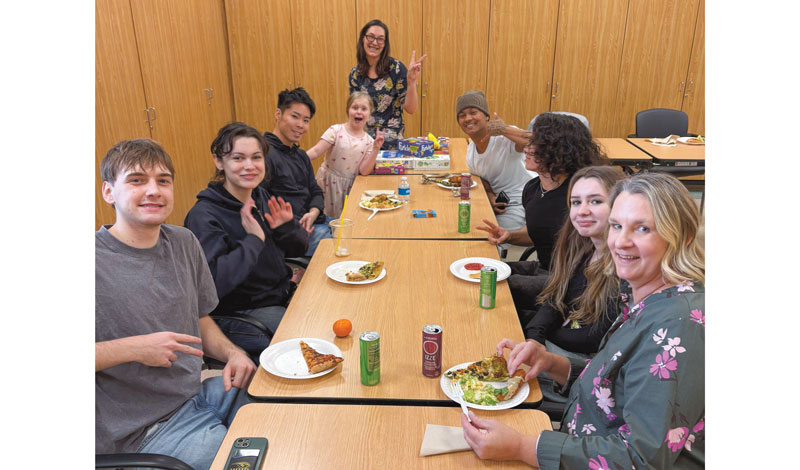
Our movement for peace always begins with the person in front of us.
The conference opened with SGI-USA General Director Adin Strauss announcing a leadership appointment: Rishi Wadhwa, West Territory Men’s Leader.

West Territory
Men’s Leader
Strauss touched on some of the ways that the youth are developing OYIH on the front lines, including chapter youth hangouts, topic-based intro-to-Buddhism meetings and creative discussion meetings.
Whatever creativity we employ, Strauss said the main point remains the same—to meet with and offer heartfelt encouragement to the person in front of you so that they can stand up with a vow to share Buddhism and elevate the life state of our country. Sensei writes:
It is the explosion of faith in the microcosm of an individual that causes the macrocosm of the organization—a gathering of many such individuals—to commence its revolution.[2]
Strauss expressed his resolve “that it is my responsibility and my opportunity to resolve (any roadblocks to the goal) in a way that would truly please my mentor,” he said.
“I appeal to all who are part of this CEC to refresh this determination in your own heart, with respect to your own organizations, from this moment forward,” he said. “Will you join me?”
One Youth. Infinite Hope.
Regarding the overarching focus, the CEC members voted to enact the following:
Establishing goals and offering support: With more than 13,000 members having signed the peace pledge, the next step is to ensure that every organization establishes it own youth shakubuku goal for 2026 and toward 2028. Part of that effort will be to support the members who signed the peace pledge in their efforts to introduce young people to the practice.
Leaning into creativity at the front lines: For districts, this means to challenge coming up with fresh, creative agendas and small-group dialogues, as many youth guests appreciate this format.
Meeting youth where they’re at: At the chapter, region and zone levels, the focus is on holding consistent, informal youth hangouts and trying new ways to have joyful gatherings that are genuinely attractive to youth. In this era of innovation, leaders should feel empowered to try new and creative approaches toward our OYIH movement.
Chapter Assignments
The chapters represent the hub of the OYIH movement. Now that all SGI-USA chapters have set their own youth shakubuku goals, the CEC members voted to strengthen chapter assignments.
What the chapter assignment looks like: Region through national women’s and men’s leaders have been assigned to chapters to be a source of steady support. This includes attending planning meetings, doing visits with district and group leaders, chanting abundant daimoku for the chapter’s goals; and supporting their efforts to keep track of and care for all potential new youth members. A big focus will be creating fresh and innovative activities to inspire all members to support youth shakubuku this year.
Youth leader focus: For youth leaders at the region through national levels, their focus will be to support local youth activities and help generate excitement and momentum through new and informal youth hangouts.
Danny Nagashima, the Pacific Zone leader, shared about his own chapter assignment, where the team not only created a list of all their youth guests, but also got together to make leis for each one as a cause for their happiness.
Danny said they have broken up their goals toward 2028 into half-year increments so they can challenge—and celebrate—them as milestones.
He then spoke of a young man in Guam, whom he got to know after Typhoon Mawar devastated the island. Although this young man was as a teenager, Danny encouraged him to stand up with a big dream, like becoming the governor of Guam, so that he could change the island. This young man recently accomplished the first step toward that goal, learning recently that he was accepted into the Class of 2030 at Soka University of America.
Danny underscored his point by sharing Sensei’s guidance on youth: “Young people are works in progress, not yet complete. That’s what makes each young person an unknown quantity with limitless potential.”[3]
OYIH is our driving cause for peace.
The CEC members discussed other topics, including our annual May Commemorative Contribution activity, a key statistics overview, updates to our District Leaders’ Toolbox in the SGI-USA Member Portal, the youth-led 3-Minute Gosho at discussion meetings, and future division and student division reports. But above all, the quintessential focus was and is OYIH.
In closing encouragement, Monica Soto Ouchi, the SGI-USA women’s leader, shared from The Heart of the Lotus Sutra, where Sensei explains why ordinary people have to suffer on account of war and other hostilities, using the Gosho passage: “Buddhism is like the body, and society like the shadow. When the body bends, so does the shadow.”[4]
Sensei elaborates:
A body and its shadow are inseparable. If bends in the “body”—distortions of philosophy, thought and religion—are not rectified, then all attempts to produce a straight “shadow” are bound to fail.
Through our movement to conduct dialogue, we contribute to society on a fundamental level by helping straighten out this “body.” We are creating the inherent cause for peace and prosperity.[5]
“This,” she said, “personifies what we’re going to accomplish through ‘One Youth. Infinite Hope.’”
A Commitment to Peace
Since Jan. 1, thousands of members have signed the petition making a clear determination to personally support the happiness and growth of one young person this year by having them begin their Buddhist practice.
With this shared determination, SGI-USA members are stepping forward to unite with the youth to shape the future of kosen-rufu—one young person at a time.
To all SGI-USA Members,
The youth of SGI-USA are committed to taking the initiative to create a peaceful, harmonious community where everyone in our environment can be absolutely happy, starting with ourselves. Though it may seem to be the long way to achieve this, our conviction is that the direct way to make this a reality is by meeting one-to-one, having heartfelt dialogues and sharing our Buddhist practice with everyone around us.
Ikeda Sensei says: “Kosen-rufu is a comprehensive revolution based on the revolution of the individual. … The effort to introduce Buddhism to a single individual and thereby transform [their] life is the most gradual and certain path of nonviolent revolution. Furthermore, to live dedicated to kosen-rufu is the best way of life for a genuine reformer” (The New Human Revolution, vol. 14, revised edition, pp. 19–20).
By signing this petition, you are committing to introducing at least one youth this year to start their Buddhist practice with the SGI-USA. Together, we can transform society and elevate the life condition of humanity.
Let’s promise to achieve this together!
Click here to sign the petition.
April 3, 2026 World Tribune, pp. 6–7
References
- May 2026 Living Buddhism, p. 13. ↩︎
- My Dear Friends in America, fourth edition, p. 21. ↩︎
- The Wisdom for Creating Happiness and Peace, part 2, revised edition, p. 331. ↩︎
- A Comparison of the Lotus and Other Sutras,” The Writings of Nichiren Daishonin, vol. 1, p. 1039. ↩︎
- The Heart of the Lotus Sutra, p. 120. ↩︎
You are reading {{ meterCount }} of {{ meterMax }} free premium articles