

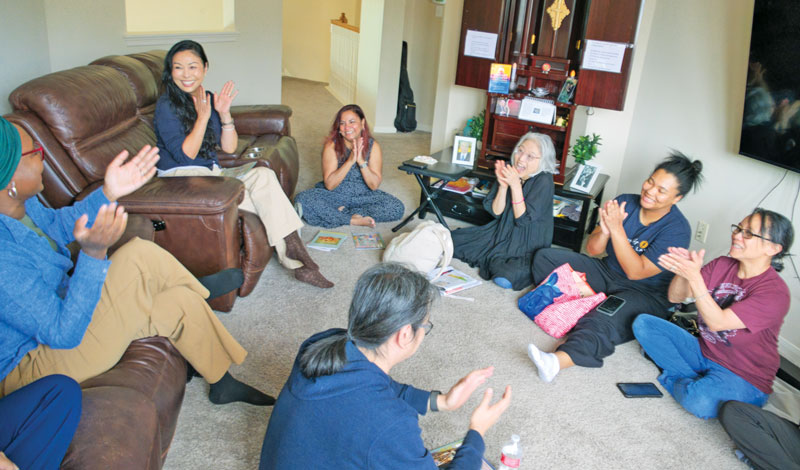
Please present the 3-Minute Gosho (pp. 46–47) at your discussion meetings. For the main study portion of the meeting, you can choose to expand on the 3-Minute Gosho or choose from one of the following:
1) What Do You Think? (pp. 48–49)
2) Material from any recent issue of the World Tribune or Living Buddhism.

3-Minute Gosho
Creating a ‘Shimmering Buddha Land’ Built on Compassion
Passage
Therefore, you must quickly reform the tenets that you hold in your heart and embrace the one true vehicle, the single good doctrine [of the Lotus Sutra]. —“On Establishing the Correct Teaching for the Peace of the Land,” The Writings of Nichiren Daishonin, vol. 1, p. 25
Background
Our beliefs shape the way we think and act. In this passage, Nichiren Daishonin encourages us to “reform the tenets” that we hold in our hearts. It means to change the beliefs that keep us from respecting our own worth or the value of others.
To help awaken people to Buddhahood, or the limitless potential in every life, he wrote “On Establishing the Correct Teaching for the Peace of the Land.” On July 16, 1260, he presented this writing to Hojo Tokiyori, the most powerful leader in Japan.
In it, Nichiren explains that the suffering, conflicts and even natural disasters of his day arose from beliefs that do not respect human life.
“Establishing the correct teaching” means sharing and practicing the Lotus Sutra’s message of respecting life. “Peace of the land” means creating a safe and fair world where everyone can thrive. When we believe in each person’s potential and treat others with compassion, we can build peace in our homes, communities and country.
From Ikeda Sensei’s The New Human Revolution
During the Soka Gakkai’s annual summer training course in August 1961, Ikeda Sensei (who appears in the novel as Shin’ichi Yamamoto) lectures on Nichiren Daishonin’s treatise “On Establishing the Correct Teaching for the Peace of the Land,” commenting on this passage.
What is the surest way to bring peace to the land, to transform a society that is weighed down with misfortune and suffering? Nichiren stresses that it begins with one person establishing the truth in his or her heart. The “one true vehicle, the single good doctrine” of which he speaks is the Lotus Sutra, the correct Mahayana teaching that espouses life’s supreme worth and dignity and instructs that all living beings are essentially Buddhas. When each individual awakens to and reveals his or her inherent Buddhahood in accord with this Mystic Law, the place that person lives becomes a shimmering Buddha land.
The goal of Nichiren Buddhism is to create peace and prosperity in society by equipping individuals—the prime movers of society and shapers of the times—with the inner requisites to triumph in all endeavors. “On Establishing the Correct Teaching for the Peace of the Land” reveals the underlying principle for achieving this. Because Buddhism regards all beings as Buddhas, it finds absolute dignity and limitless potential in each individual. These same ideals constitute the unshakable philosophical basis of democracy.
Moreover, as we bring forth our inherent Buddha nature, we develop compassion for others. “Embracing the one true vehicle, the single good doctrine [of the Lotus Sutra]” means, in one sense, abandoning all prejudiced and partial views of life and humanity and returning to a respect for the supreme dignity of life. It means doing away with egoism and living by the rule of compassion, basing ourselves on true humanism. Here we find the universal principle that provides the key to humankind’s prosperity and peace on Earth. (The New Human Revolution, vol. 4, revised edition, pp. 247–48)
Presenting this month’s 3-minute Gosho? Click here for a brief tutorial video.
What Do You Think?
What Does It Mean to ‘Change Poison Into Medicine’?
When we run into problems, it’s natural to feel upset, discouraged or even overwhelmed. Fortunately, Buddhism offers a powerful way to view and approach them. The principle of “changing poison into medicine” helps us understand that no matter what kind of problems or obstacles we face, we can fundamentally transform them into something positive through chanting Nam-myoho-renge-kyo.
The character myo in Nam-myoho-renge-kyo, meaning “wonderful” or “mystic,” expresses this idea. The Buddhist scholar Nagarjuna[1] said that the word myo is “like a great physician who can change poison into medicine.”[2]
Nichiren Daishonin explains this principle in the following way:
What is the poison? It is the three paths of earthly desires, karma, and suffering that are our lot. What is the medicine? It is the Dharma body, wisdom, and emancipation. And what does it mean to change poison into medicine? It means to transform the three paths into the three virtues: the Dharma body, wisdom, and emancipation.[3]
Here, Nichiren describes “poison” as the three paths: 1) earthly desires, which arise from delusions rooted in greed, anger and foolishness; 2) karma, or actions driven by those desires; and 3) suffering, which results from earthly desires and karma. Because each leads to the next, they are called “paths.” When caught in this self-perpetuating cycle, people cannot reveal their Buddhahood.
He then explains that “medicine” refers to the three virtues: 1) the Dharma body, or the truth—the true aspect of all phenomena—realized by the Buddha; 2) wisdom, the capacity to perceive that truth; and 3) emancipation, the state of being free from the sufferings of birth and death.
What Does Changing Poison Into Medicine Look Like?
What might this look like in daily life? If we lose a job, we at first might feel overwhelmed by anxiety, anger or discouragement. From the perspective of Nichiren Buddhism, those feelings do not mean failure; they are part of the “poison” of suffering and delusion that everyone experiences. By chanting Nam-myoho-renge-kyo, however, we can bring forth wisdom, courage and life force.
The situation may not change overnight, but chanting can help us break free from the grip of fear, resentment or hopelessness. Instead of giving up or blaming others, we begin to see fresh possibilities, fortify our resolve and take actions needed to break through. In this way, the very hardship that once caused us nothing but pain can become a catalyst for developing a stronger self, creating value and encouraging others who may be going through similar struggles.
This is one way to understand what it means to change poison into medicine.
From this perspective, our obstacles always have profound meaning and value. Because we have sufferings, we can chant earnestly to win over them. The resolve to overcome our challenges is what causes our inner power to emerge. Ikeda Sensei explains:
At the moment we chant, our sufferings—our earthly desires—have already become causes for enlightenment. It could even be said that our earthly desires in fact contain enlightenment. In a sense, earthly desires themselves undergo a qualitative change from “earthly desires that cause suffering” into “earthly desires that can be transformed into enlightenment.” It is the power of Nam-myoho-renge-kyo—the Mystic Law of the simultaneity of cause and effect—that makes this possible.[4]
As we strive to practice Buddhism correctly, we can transform the “poison” of negative karma and suffering into the “medicine” that awakens our limitless potential. Problems will always arise. But no matter how difficult things get, we can use those challenges to fuel our prayers. In doing so, we develop the wisdom, strength and resilience to overcome any obstacle and create lasting value.
—Prepared by the SGI-USA Study Department
From the July 2026 Living Buddhism
References
- Nagarjuna: A Mahayana scholar of southern India thought to have lived between the years 150 and 250. His many writings, which include The Treatise on the Middle Way and The Treatise on the Great Perfection of Wisdom, elevated Mahayana Buddhism and had a major impact on Buddhism in China and Japan. ↩︎
- A phrase from Nagarjuna’s The Treatise on the Great Perfection of Wisdom. See “What It Means to Hear the Buddha Vehicle,” The Writings of Nichiren Daishonin, vol. 2, p. 743. ↩︎
- “What It Means to Hear the Buddha Vehicle,” WND-2, 743. ↩︎
- The Heritage of the Ultimate Law of Life: SGI President Ikeda’s Study Lecture Series, p. 135. ↩︎
You are reading {{ meterCount }} of {{ meterMax }} free premium articles