
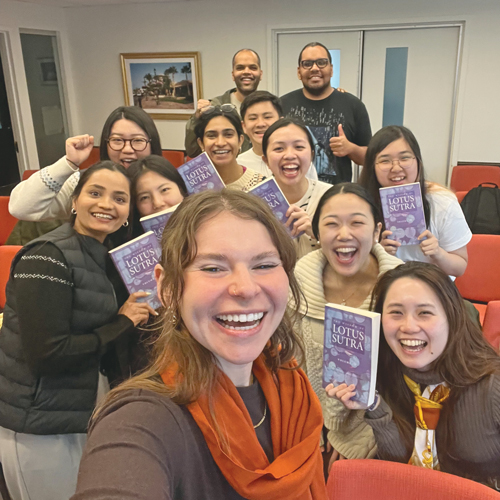
Ikeda Wisdom Academy members:
• are group through national youth leaders and all student division members.
• should have their own copy of The Wisdom of the Lotus Sutra, vol. 5.
• are encouraged to read the assigned material before each meeting.
March Syllabus:
The Wisdom of the Lotus Sutra, vol. 5, pp. 29–52
Part Two: “The Benefits of Responding with Joy” Chapter
2: “Joyfully Spreading the Mystic Law”
Supplementary Material:
• The Lotus Sutra and Its Opening and Closing Sutras, pp. 286–91
• The Record of the Orally Transmitted Teachings, pp. 146–47; pp. 234–35
Chapter Overview
Responding With Joy Produces Benefits Even to the ‘Fiftieth Person’
In discussing the Lotus Sutra’s 18th chapter, “The Benefits of Responding with Joy,” Ikeda Sensei highlights its central message: When we respond with joy in practicing Buddhism, we receive tremendous benefit. He writes that “we receive great benefit to the extent that we joyfully exert ourselves in faith.”[1]
Buddhist sutras typically unfold in three parts: the preparation section explains why a sutra is expounded; the revelation section presents its core teaching; and the transmission section describes the benefits of the teaching and passing it on to future generations.
The Lotus Sutra’s transmission section begins in chapter 17, “Distinctions in Benefits,” which we studied last month. Chapters 17 through 19 describe the profound benefits that arise from upholding and spreading this sutra’s teaching of respect for all life.
In chapter 18, Shakyamuni Buddha illustrates this through the benefit reaching the “fiftieth person” who hears the sutra:
After the thus come one has entered extinction, suppose there are [people who, hearing this sutra, respond with joy and] put forth effort in preaching and expounding for the sake of their parents and relatives, their good friends and acquaintances. These persons, after hearing, respond with joy and they too set about spreading the teachings. One people, having heard, responds with joy and spreads the teachings, and the teachings in this way continue to be handed along from one to another until they reach a fiftieth person. (The Lotus Sutra and Its Opening and Closing Sutras, pp. 286–87)
These benefits are described as surpassing even the merit of giving riches and fulfilling the desires of all living beings for 80 years!
Nichiren taught that a person who chants or even hears Nam-myoho-renge-kyo once and rejoices will receive blessings “a hundred, thousand, ten thousand, million times greater”[2] than those gained by Shakyamuni’s wisest and foremost disciples.
For SGI members, this chapter is not abstract theory; it is a lived reality. By engaging others with sincerity and joy, and sharing Buddhism with one person and then another, we embody its spirit.
“Joy is something we share with others,” Sensei says. “To be concerned only with one’s own happiness is egoism. To claim you care only about the happiness of others is hypocrisy. Genuine happiness is becoming happy together with others” (WLS-5, 37).
In this way, we are creating an ever-growing network of benefit and joy.
—Prepared by the SGI-USA Study Department
Ikeda Sensei’s Guidance
Realizing True Democracy—Individual Happiness and Social Prosperity
Propagation from one person to the next and so on to the 50th person is the democratic path of dialogue. Democracy is definitely not simply a matter of setting in place certain forms and institutions. Without content, democracy is an empty vessel that is easily crushed.
What is this content? It is individual self-reliance and self-improvement. It is individual happiness. Democracy must enable each person in society to live to the fullest. Without valuing the sanctity of the individual, democracy is a mere shell. …
When people’s hearts are vacant, democracy is imperiled, and the devilish potential of power can set in. That is when the dark shadow of nationalism begins to spread.
[Second Soka Gakkai President Josei Toda] said that individual happiness and social prosperity must go hand in hand. It is a grave mistake for society to neglect the well-being of the individual while striving only for economic growth. Individual happiness is not self-centered; rather, it is the process of solidifying one’s humanity, of developing wisdom and compassion in both oneself and others.
This is an issue of global importance, affecting socialist and democratic countries alike. The Lotus Sutra, however, has the power to enable all people to realize both individual happiness and social prosperity. This is the meaning of actual three thousand realms in a single moment of life.
In short, it is our efforts to pray for and help other people become happy that are the hallmark of the foremost popular movement and that directly contribute to the creation of a truly democratic society. We are engaged in transmitting joy from one person to another. No matter how long or broad the chain of transmission, the amount of fulfillment each person feels does not wane nor is anyone made to suffer. The propagation of Nichiren Daishonin’s philosophy continues as each person becomes indestructibly happy. This is the path we have followed. (WLS-5, 39–40)
Digging Deep
March Study Guide
Please use these questions to guide your study of The Wisdom of the Lotus Sutra, vol. 5, pp. 29–52.
1) What does Ikeda Sensei say is the meaning of the title “Benefits of Responding with Joy,” and what does this chapter clarify? (WLS-5, 29)
2) “The Benefits of Responding with Joy” chapter lists three types of benefits received by a person who hears the Mystic Law. What are they? (WLS-5, 48–49)
3) The Lotus Sutra lists 50 kinds of benefits a person will receive from encouraging others to learn about the Mystic Law, including enjoying a state “in which all desires are fulfilled” (WLS-5, 49). In short, what does Sensei say about dedicating one’s life to kosen-rufu, propagating the Mystic Law and arrogance? (WLS-5, 49–51)
Looking Forward: April Syllabus
The Wisdom of the Lotus Sutra, vol. 5, pp. 55–85
Part Three: “Benefits of the Teacher of the Law” Chapter 3: “Those Who Spread the Mystic Law Can Purify Their Senses”
You are reading {{ meterCount }} of {{ meterMax }} free premium articles