
Ikeda Wisdom Academy members:
• are group through national youth leaders and all student division members.
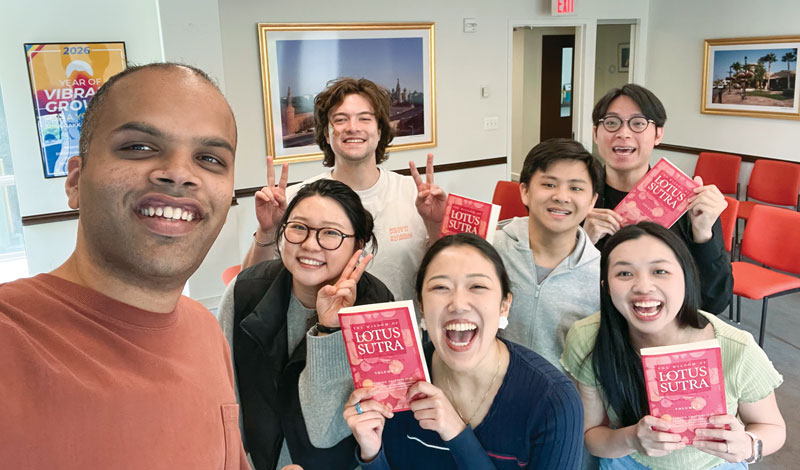
• should have their own copy of The Wisdom of the Lotus Sutra, vol. 6.
•are encouraged to read the assigned material before each meeting.
December Syllabus: The Wisdom of the Lotus Sutra, vol. 6, pp. 39–67
Part Two: “The Bodhisattva Wonderful Sound” Chapter
2: “Cultural Activities Based on the Mystic Law Are ‘Wonderful Sounds’”
Supplementary Material:
• The Lotus Sutra and Its Opening and Closing Sutras, pp. 331–38
• The Record of the Orally Transmitted Teachings, pp. 176–78
Chapter Overview
Bodhisattva Wonderful Sound’s Compassion
The Lotus Sutra’s 24th chapter describes an astounding bodhisattva named Wonderful Sound who can assume various forms (Brahma, Shakra, wheel-turning kings, monks, nuns, dragons, demons or any other form) to guide people to the sutra’s teachings in ways that best fit their unique circumstances and capacities. Shakyamuni Buddha describes him, saying:
If the form of a voice-hearer is what is needed to bring salvation, he manifests himself in the form of a voice-hearer and proceeds to preach the Law. If the form of a pratyekabuddha will bring salvation, he manifests himself in the form of a pratyekabuddha and preaches the Law. If the form of a bodhisattva will bring salvation, he manifests a bodhisattva form and preaches the Law. If the form of a buddha will bring salvation, he immediately manifests a buddha form and preaches the Law. Thus he manifests himself in various different forms, depending upon what is appropriate for salvation. And if it is appropriate to enter extinction in order to bring salvation, he manifests himself as entering extinction. (The Lotus Sutra and Its Opening and Closing Sutras, pp. 336–37)
In the remote past, for over 12,000 years, Bodhisattva Wonderful Sound made offerings to the Buddha Cloud Thunder Sound King, playing a hundred thousand types of musical instruments and presenting 84,000 alms bowls made of the seven kinds of treasures. As a result of his devotion, Wonderful Sound was reborn in the land called Adorned with Pure Light and acquired his supernatural powers that allowed him to take on various forms to spread the Mystic Law.
Nichiren Daishonin explains:
The Bodhisattva Wonderful Sound represents the “living beings of the Ten Worlds.” “Wonderful” means inconceivable, and “sound” refers to the sounds uttered by all living beings, the voice of the Wonderful Law. These are the wonderful sounds that are constantly present in the three existences. It is pity and compassion that make
it possible for Wonderful Sound to recognize and meet the various needs of the living beings [by assuming various forms]. This is what is expressed by the word “bodhisattva.” Or again, we may say that the words “wonderful sound” refer to the unfathomable and wonderful sound made at the present time, in the Latter Day of the Law, when Nichiren and his followers now chant Nam-myoho-renge-kyo. (The Record of the Orally Transmitted Teachings, p. 176)
This bodhisattva symbolizes our wisdom, compassion and dedicated efforts to spread the Mystic Law. For SGI members, he represents our prayers to the Gohonzon and efforts to support and encourage others while respecting their individuality. Wonderful Sound’s many forms reflect the diverse ways we can contribute to society while upholding our shared values of humanism and compassion.
Ikeda Sensei’s Guidance
The Voice of Courage
Ikeda Sensei: Nichiren Daishonin says that the number eighty-four thousand stands for the “eighty-four thousand dust-like cares” (OTT, 177), meaning all manner of hardships and delusions. Life is an endless succession of struggles,
struggles as innumerable as particles of dust. But when we chant Nam-myoho-renge-kyo, he teaches, these toils all become the “eighty-four thousand teachings.”
Every difficulty we encounter becomes a life lesson; wisdom and the ability to help and guide others develop. Interpreted from the standpoint of Nichiren Buddhism, Bodhisattva Wonderful Sound toiled repeatedly to overcome many sufferings, chanted Nam-myoho-renge-kyo and carried out his human revolution. This is comparable to making an offering to the Buddha of “eighty-four thousand alms bowls made of the seven treasures.” We are no different. No matter how tough things may get, we chant and continue moving forward without giving up.
Though invisible to the eye, there are paths in the universe and currents in life. If we dedicate our lives to kosen-rufu, we will absolutely enter the current of a supreme life. We will enter the path of the river of true happiness, the river of treasures. Those who exert themselves for kosen-rufu enter the golden current of the Mystic Law. By working wholeheartedly on the supreme path of kosen-rufu, we ourselves, along with our family and relatives, will all become happy without fail.
Didn’t Bodhisattva Wonderful Sound, while battling a painful destiny, in the end sing a song of victory? As he struggled and suffered, he warmly encouraged those around him, singing a courageous tune. This is the image that comes to mind. A sincere voice encouraging a friend, words of conviction that move a person’s heart, cries of justice to refute evil—these are truly “wonderful sounds.” (The Wisdom of the Lotus Sutra, vol. 6, pp. 53–54)
Digging Deep
December Study Guide
Please use these questions to guide your study of The Wisdom of the Lotus Sutra, vol. 6, pp. 39–67.
1) What does Wonderful Sound’s grand appearance in the saha world signify? (WLS-6, 41–44)
2) When Shakyamuni Buddha’s light from his forehead illuminates Wonderful Sound, what does Shakyamuni tell him? (WLS-6, 44–46)
3) When Wonderful Sound appears in the saha world, the scene is so fantastic that a bodhisattva asks, “What good roots has this bodhisattva planted, what benefits has he cultivated, that he can exercise such great supernatural powers as this?” (LSOC, 24). Shakyamuni then reveals details of Wonderful Sound’s previous existences.
How did Wonderful Sound acquire the supernatural abilities to take on any form? What is the meaning of the “eighty-four thousand dust-like cares”? (WLS-6, 52–54)
4) According to The Record of the Orally Transmitted Teachings, what is the meaning of “wonderful sound” (OTT, 176)? (WLS-6, 54)
Looking Forward: January Syllabus
The Wisdom of the Lotus Sutra, vol. 6, pp. 71–98
Part Three: “The Universal Gateway of the Bodhisattva Perceiver of the World’s Sounds” Chapter
3: “Developing the Compassion and Wisdom ‘To Perceive the World’s Sounds’”
You are reading {{ meterCount }} of {{ meterMax }} free premium articles