

by Darrel Wheatly
Gladstone, MO.
I don’t think my apartment ever felt so quiet as it did that day in 2024, coming home from the family Thanksgiving. Every year, we gathered out in east Kansas, to celebrate over turkey and ham. I was grateful now to be alone for a moment, in an apartment I had to myself. But it was also strange, something I was still getting used to after living here for four years with somebody else.
Earlier that year, my roommate and I had sat down for an overdue conversation. Our arrangement, we both knew, had grown toxic—we’d been bringing out the worst in each other. We chose to part ways, and every day since, I’d gotten more used to sitting alone with my thoughts. The feeling this gave was equal parts relief and alarm—relief at now knowing that my thoughts were wholly my own, and alarm at how much I disliked them. Suspicious, pessimistic, worried and angry, I found, at 71 years old, that I did not like who I’d become.
Suffer what there is to suffer, enjoy what there is to enjoy, I thought—a fragment of Nichiren’s writings that still popped into mind now and again, despite 25 years since I’d last practiced Buddhism. I shuffled through the entry of my apartment, into the crammed living room, past the piano gathering dust. I made my way to my bed, laid down and slept. I woke the next morning knowing what I wanted to do. The holiday weekend was not yet over, and it was unlikely there was anyone in, but I made a call nonetheless to the local SGI center and left a voicemail, explaining that I wanted to reconnect.
A few days later, I got a call from an SGI leader inviting me to the New Year’s Gongyo Meeting, taking place on Jan. 1. He even offered to give me a ride. I went, though frankly, I don’t recall much that was said. What I know is that I left with a newfound understanding of faith, which I determined to never give up again. I left understanding what Buddhism is truly about—becoming happy and helping others become happy. When I got home, I cleared a space in front of the living room wall, pulled up a chair there and began chanting Nam-myoho-renge-kyo, keeping at it for a good long time. At some point, that old passage came to me again—the one that begins “Suffer what there is to suffer…” But it occurred to me now that this was not the whole passage—that there was something missing, something I had forgotten. I found my copy of The Writings of Nichiren Daishonin and found the letter “Happiness in This World.” It reads:
Suffer what there is to suffer, enjoy what there is to enjoy. Regard both suffering and joy as facts of life, and continue chanting Nam-myoho-renge-kyo, no matter what happens. How could this be anything other than the boundless joy of the Law? Strengthen your power of faith more than ever (The Writings of Nichiren Daishonin, vol. 1, p. 681).
All this time, I’d thought this passage was a call to stoicism, and all this time, I’d been wrong. How had I forgotten its second half, calling clearly for me to strengthen my faith? Energized, I dusted off my piano that day, sitting down to compose and to play.
From one perspective, nothing had changed; from another, everything had. My morning routine remained much the same, but I moved through it eagerly now. My prayer became to share Buddhism with my actions and words. I saw that my music, my work, my family and community, were all part of my mission to create happiness in this world, here and now. I began to share freely with my whole crew at work— mostly Christians, but they caught the drift. To my surprise, one young friend, who works the grill like me, was enthusiastic and dove right in. Embraced by our Soka family here in Gladstone, he received the Gohonzon that May. How can I create happiness here with this person? I began to ask myself. I kept this question in mind with whomever I spoke, even when that person was miles away.
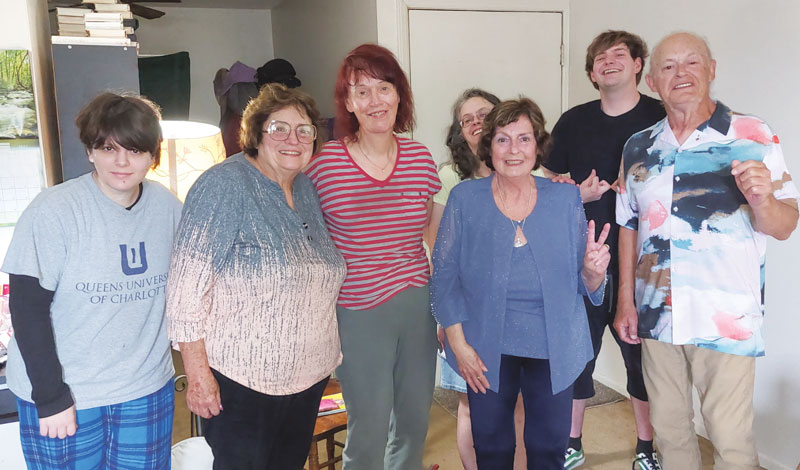
That February, I got a call from my daughter, in which she confided something she’d been keeping to herself. Her long-term relationship had become increasingly toxic, to the point that it had now become dangerous. I invited her to come stay with me for as long she needed but saw she might not take me up on the offer right then. I told her I was again chanting Nam-myoho-renge-kyo, and what a huge difference that had made in my life. When she told me she was not in a place where she could safely chant, I determined to pray fiercely for her protection. From that day on, I made every cause I could think of to build a Buddha land right where I was, and that would extend to my daughter somehow.
As though in answer to that prayer, I was asked to take on district leadership. When asked if I could host our monthly discussion meeting, I said yes again, making space by getting rid of old, unused furniture. Every month, we squeeze into my little apartment, where we have wonderful discussions, about our worries and struggles, our victories and dreams, all based on the hope-filled teachings of Nichiren Buddhism. I can’t help but think how much my home has transformed—from a place where even I did not want to be, to a place that everyone enjoys.
This February, my daughter called again. She’d chanted furious daimoku and decided to get out of her bad situation. She arrived a week later and didn’t miss a beat—like me, she’s a morning person. Around 7, one of us puts on the coffee, which we take together to the patio outside. It’s no longer so quiet, with the two of us chatting (plus our new neighbor who’s hard of hearing and likes to chime in). Then we head in to do gongyo together, to prepare for the day ahead. She’s definitely changed a lot since she got here—she’s much calmer and more confident. She’s found work and has been reconnecting with old friends while making new ones too. The main thing, I think, is that she seems so much happier. In fact, the same can be said, I’m told, for myself.
“You’re so much happier than when I first met you, Darrel!” my men’s leader recently said. And he’s right, I am—it’s never too late to become happy right here, right now.
You are reading {{ meterCount }} of {{ meterMax }} free premium articles