
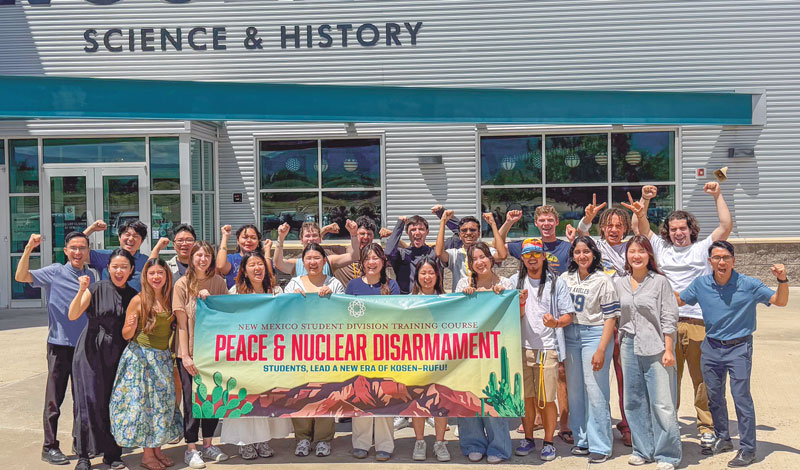
ALBUQUERQUE, N.M.—Of all the Atomic Age relics on display at the National Museum of Nuclear Science and History, perhaps the most telling were the children’s toys.
Among them: a 1947 Kix cereal “Atomic Bomb Ring” featuring an adjustable gold-colored band topped with an aluminum nuclear warhead. The premium toy could be ordered by mail for 15-cents and a cereal box top.
The museum tour was part of the first SGI-USA student division training course on peace and nuclear disarmament, held July 10–13, at the University of New Mexico, with 24 college students from throughout the country.
The location was chosen given its significance. On July 16, 1945, the world’s first nuclear weapon was detonated at the Trinity site in the New Mexico desert, ushering in the nuclear age. Less than a month later, atomic bombs were dropped over the cities of Hiroshima and Nagasaki, killing tens of thousands of people in an instant, changing the very nature of warfare.
Amid today’s rising global nuclear tensions, this intensive training course was organized to empower the next generation of youth leaders to deepen their understanding of these historical legacies, actualize nuclear abolition and advance the dignity of life through the lens of Buddhist humanism.
Grounded in a Philosophy of Peace
The youth anchored their daily efforts by reading the enduring message from Ikeda Sensei to the September 2007 Civil Society Peace Forum at The Cooper Union to mark the 50th anniversary of second Soka Gakkai President Josei Toda’s Declaration for the Abolition of Nuclear Weapons.[1] With this message as the centerpiece, the students embarked on a four-day journey of learning, reflection and empowerment.
The first full day began with the youth studying Sensei’s commentary on Nichiren Daishonin’s landmark treatise “On Establishing the Correct Teaching for the Peace of the Land,” underscoring how our natural and social environments mirror the human heart.
In the afternoon, facilitators Eddie Laiche, an SGI campus club leader at California Polytechnic State University, San Luis Obispo, and Hana Peck, a recent graduate from the University of Arizona, led back-to-back sessions examining the human consequences of nuclear weapons.
Later that afternoon, Sahaja Rutledge, an SGI campus club leader at Utah Valley University, presented on how we could anchor a philosophy of peace within daily life, using the example of Bodhisattva Never Disparaging to underscore that peacebuilding is not a distant institutional task but a daily responsibility.
The day ended with a guest lecture by Sophie Stroud, the communications director of Nuclear Watch New Mexico, who reminded the participants that public awareness and compassionate dialogue are our greatest tools to turn the tide of public opinion in favor of nuclear abolition.
Hospitality That Inspired Hope
From the moment the participants arrived, the profound spirit of Soka hospitality was on full display. Local SGI-USA members warmly welcomed the students upon their arrival at the airport and provided transportation throughout the conference.
Every day, they surprised the youth with thoughtful, handmade gift bags that included hand-signed postcards with words from Sensei, local snacks and sunflower seeds.
On Sunday, the participants visited the nuclear science museum and then returned to campus for a session on the strategy of “gradualism” and the mechanics of dialogue, drawing from Sensei’s published dialogue with David Krieger, Choose Hope: Your Role in Waging Peace in the Nuclear Age.
The training course culminated with individuals and groups sharing showcasing their synthesized learnings, vows and reflections in the form artwork and poetry. These pieces were later compiled into a beautiful collaborative “zine.”
The local members hosted a commemorative dinner, featuring home-cooked food.
Carrying the Flame of Peace Forward
The foundational spirit of this training course traces directly back to the profound struggle of the three eternal mentors of the Soka Gakkai. Second Soka Gakkai President Josei Toda was released from prison during World War II in July 1945—the very same month that the Trinity Test was conducted on New Mexico soil. In September 1957, he issued his historic Declaration for the Abolition of Nuclear Weapons, condemning these armaments as a manifestation of absolute evil.
Toda had the insight to understand that the logic that justifies the possession of nuclear weapons grows from the most extreme form of human desire—the desire to dominate and bend others to our will, the readiness to annihilate them, destroying their lives and livelihoods, should they resist.[2]
Inheriting this vow, Sensei dedicated his life to making nuclear abolition a reality, authoring over 40 annual peace proposals that offered concrete, pragmatic solutions to disarmament and other pressing global crises.
Following this historic gathering, which represented a grand counteroffensive for peace on the 250th anniversary of America’s founding, the student division leaders returned to their regions across the country with a shared commitment to carry this flame onward toward introducing 10,000 youth to the SGI-USA by Jan. 2, 2028, and forge a new era of global humanism.
You are reading {{ meterCount }} of {{ meterMax }} free premium articles