

Living Buddhism: Hi Celize! You’re speaking with us from Dallas, where you moved back to a few years ago. Your mother raised you there, is that right?
Celize Christy: That’s right, I was raised by a single mother. Though neither of us ever felt that way. You know that saying, “It takes a village”? That’s the truth and has made me who I am today. We had a village, a family in the SGI.
Tell us about that.
Celize: We’ll have to start with my mom, who moved from Panama to the United States in 1976, at 21 years old. She made the move with my aunt. Of the two of them, my mom had a rough grasp of the basics of Buddhism, having encountered it in Panama. It was only after the move, however, that she dove in, committing to this community, philosophy and practice and gaining from it the strength to make a life for herself. In a year, she was able to introduce her sister to the practice as well; and they both received Gohonzon together in 1977.
When I came around 20 years later, she was still working hard to make a living. But here’s the point: Though I hardly remember a day she took off from the housecleaning work that paid our bills, I wasn’t lonely. I had a whole village who impressed on me from the time I was born that I was cherished, respected and never alone. At the crucial moment, there was always someone to remind me.
For instance?
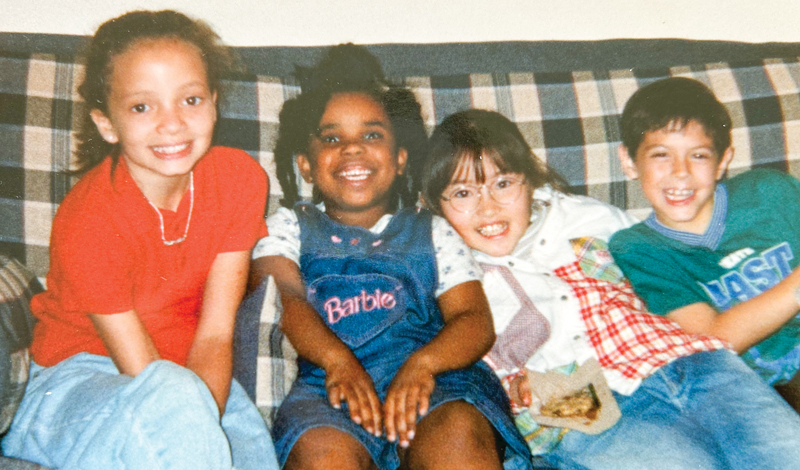
Celize: For instance, a birthday—my 10th, I think. I was in the fifth grade at that time when it was anyone’s birthday their parents would bring a cake for the entire class during lunch and celebrate. Of course, I was the exception—my mother, I knew, would be working and therefore could not bring a cake. I was disappointed and felt let down on my birthday, not at my mom, but at the facts—the unfairness of them.
When lunchtime came, I felt every eye on me, wondering when the cake would come. I was about to tell them all to stop their stupid waiting when something magical happened. But there was a knock at the door, which my teacher swung open to reveal someone I knew—my mother’s close friend, our women’s chapter leader. She came in beaming and holding a cake, plates and cups. She and my mom had coordinated ahead of time.
It might sound small, but not to me. I was reminded, at that crucial moment, that I had not been, and never would be, forgotten or alone.
It left a deep impression. What about later on?
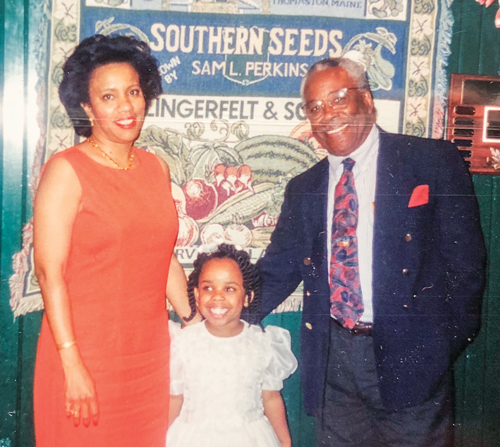
Celize: My SGI community only became more vital especially as a teenager. I don’t know what I would have done without it, for instance, when a classic case of high school drama cost me all the friends I had.
Oh, man. What was that like?
Celize: Like, it was bad. For the sake of time, it will have to simplify by saying it was all boy drama and it split my friend group apart. I tried to stay out of it, and this was as disastrous as if I’d taken sides. Overnight, I was iced out from my friends,
I began eating lunch alone in class, while my teachers graded the papers of my peers.
Of course, I was devastated, but I was also fortunate. Many kids in that situation don’t have what I had—a whole flock of older sisters. I’m talking of course about the young women I grew up with in the SGI. They noticed something was wrong right away and took me out for frozen yogurt, gently nudging until I opened up slowly. They listened and hugged me and then, eventually, asked if some part of me still wanted to be friends. I couldn’t say that for sure. They suggested I chant about that, to find the answer for myself.
I started chanting every morning before school and found to my surprise that the dread in my stomach would melt away. After chanting, I felt alright—even good, even excited—about going to school. Meanwhile, I got closer than ever with my sisters in the SGI, regularly meeting up and even, around the center, tagging along during their Byakuren shifts.
In time, I realized that I did still want to be friends and began to chant for the courage to engage the girls who’d cut me off, not in a confrontational way, but as an open question, the one I’d been asking myself in the mornings: “Do you want to talk about what happened?”
As it turns out, they did. I took responsibility for my part, and they, for the first time, recognized how difficult a situation I’d been put in. We began talking and hanging out again and, by the end of our high school careers, were closer than ever.
To this day, we are still friends. And I can say the same for the young women—my older sisters in faith—who supported me during that time.

It’s wonderful to have friends like this at a time like that.
Celize: Because of them, I wasn’t isolated and alone. I didn’t spiral. Instead, I came to see that painful time as an opportunity to strengthen my sense of self and my studies.
When I graduated high school, I was accepted to Iowa State, where I went on to receive a double major in animal science and global resource systems.
It is possible that I overcorrected a bit—diving so deeply into my college studies that I could hardly attend SGI activities.
It was not until I pursued my master’s at Pennsylvania State that I felt, suddenly and for the first time in my life, on my own. My aunt, the one who’d received the Gohonzon with my mom in ’77, did not live far from campus. My first week in Pennsylvania, I drove out two and half hours east to see her.
“Why not connect with some of the young women here?” she asked, to which I gave a noncommittal shrug. Likely that would have been the end of that had she not already given out my number.
No sooner had I got back to my apartment than my phone rang—the young women’s leader wanting to grab coffee. We did, it was great, and we agreed to do it again, at least once a month. On its face, it was a small thing, but in fact, hers was a four-hour roundtrip.
It was there in Pennsylvania that I truly embraced the practice as something entirely my own. But it was back in Iowa, where I moved for work after graduation, that I applied my faith in society.
You were working with farmers, is that right?
Celize: Right. And I liked the work. I’d worked hard to get it. But for whatever reason, I felt like an imposter, like I didn’t deserve to be there.
“You’ve got to have more confidence!” my supervisor at that time told me after one presentation early on. As one of the only women on the team, she explained, I had to exhibit confidence to inspire respect. I kept quiet but was boiling inside. Not because I didn’t agree, but because she hadn’t given any guidance I could use to succeed the next time around.
How did you break through?
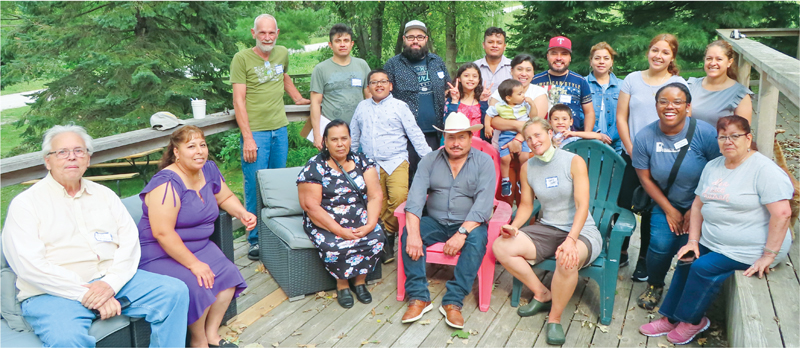
Celize: I took on SGI leadership. Initially, I did not see how this had any bearing on my situation at work—I was quite hesitant to say yes to the opportunity, disbelieving that I was capable. With some daimoku and a friendly nudge, however, I said yes to leadership in my rural community on the frontiers of our movement, a full two-hour ride from a Buddhist center.
Visiting the young women in my chapter, I began to weed out my insecurities, in a way I’d have never managed to do on my own.
How so?
Celize: First off, each visit helped see beyond my own problems and try to focus on the person in front of me. Often, I’d do the visits with the district and chapter women’s leaders, chanting with them ahead of time about the person we were going to see. After the visit, we’d talk about how it went and strengthened our prayer for that person’s happiness. What had they shared? What were they chanting for? Had they found what we studied to be relevant to their current challenges and goals? What could we study next time?
The young women were struggling with many things, but what seemed to be at the heart of them was a lack of confidence. And this was precisely what I was struggling with the most.
My zone women’s leader was a no-nonsense kind of person, who cut to the chase. When I asked how I could encourage someone to believe in themself when I didn’t believe in me, she called me out.
“So you don’t believe in yourself,” she began. “Then I’ve got a question for you. Do you believe in Nam-myoho-renge-kyo? Do you believe that chanting works?” Yes, I said without hesitation—I did. “And do you believe in the Gohonzon?” Yes, absolutely. “Well both of those are you—your life. So tell me, how can you believe in them and not believe in you?” This was a good question.
How did you resolve this question?
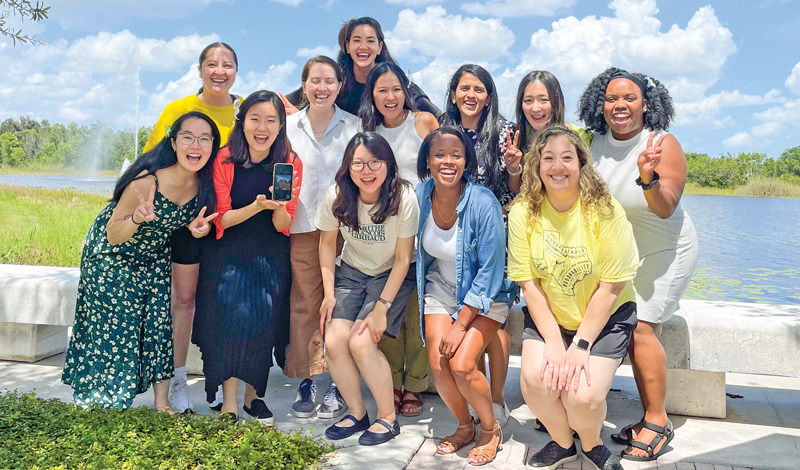
Celize: I carried it with me to the Gohonzon and also to the visits I did with the young women of my region—two of them, in particular. One was developing a vital pandemic-era software product for a university school system—something she could not do without collaborating with a volatile and difficult co-worker. The other was struggling to balance SGI activities, work, school and the Air Force reserve.
With these two young women, I established a weekly rhythm of catching up, chanting and studying Buddhism.
Understandably, early on, I found them often in a state of being overwhelmed. But as the weeks progressed, our perspectives began to shift. Yes, we could each reasonably view our lives as a series of endless battles, but from the standpoint of Buddhism, these very battles were, in fact, a series of endless opportunities to grow. Polishing our lives in this way, we began to see clearly what strides we’d made the week before and what opportunities were available to us in the coming week.
Chanting and taking action for our personal victories while chanting for one another’s, we began reporting weekly breakthroughs.
What was your realization during this time?
Celize: I realized that I was expecting my supervisor to know what I needed without telling her. This was breeding in me resentment and an unwillingness to collaborate. I decided to take action, sitting down with her to explain what I needed: concrete suggestions I could put into practice. She offered constructive feedback and clear benchmarks for progress.
Remaining open and courageous for that exchange was a wonderful thing for my life—learning how to stand up for myself. Putting her feedback to use, I found, increasingly, that I could lead as Celize, without having to become somebody I was not.
The young women I met with monthly were experiencing the same thing at work and school. In 2022, both accepted SGI leadership. I too said yes to every opportunity offered in the SGI and also to the doors that continued to open at work.
It was clear to me that the two were connected—viewing challenges as opportunities.
Could you share about what happened at work recently?
Celize: The other day, the director of my nonprofit took me aside and said something that surprised me. We were at a large summit for people representing each part of the food and farming system. “Celize,” she said, “I just want to tell you that I appreciate what you do so much—you are really good at taking care of people.”
For a moment, I didn’t know what she was talking about. Then I thought, she must have seen how I was engaging each attendee with warm care.All this was, for me, second nature—what I’d learned from my community in the SGI.
Recently, my supervisor advocated for me to get a raise. I struggled to accept it, feeling like I hadn’t done enough to earn it. But this time, I’m determined—to believe in myself as Sensei would—not only for myself but for others to be able to believe in themselves as well.
You are reading {{ meterCount }} of {{ meterMax }} free premium articles