
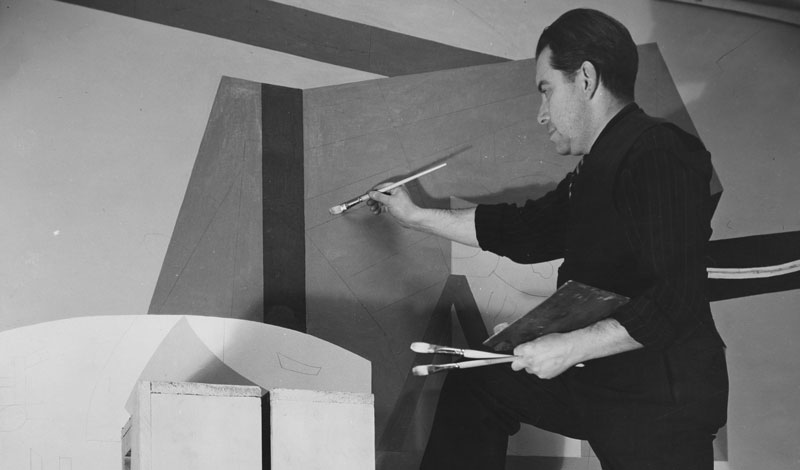
Born in Philadelphia in 1892, Edward Stuart Davis was introduced to the art world at an early age. His mother worked as a professional sculptor, while his father was the art editor for a newspaper. Raised in an environment that actively encouraged creative expression, Davis developed a passion for the visual arts during his childhood.
In 1909, he decided to leave high school and relocate to New York City, where he enrolled at an independent art school. To support himself financially while completing his studies, Davis began working as a commercial illustrator, and by 1912, he was producing drawings for magazines.
At 20, he participated in the groundbreaking New York Armory Show, which became the turning point in his art career. As one of the youngest American artists at the exhibition, Davis was exposed to new European art movements, specifically fauvism and cubism. This direct contact with modern art inspired him to abandon traditional realism.
As his work developed, Davis moved further toward abstraction. Bright reds, yellows, blues and greens filled his canvases, along with bold lines, letters and overlapping shapes. Still, the everyday world was rarely far away.
One example appears on the cover of this issue. Davis created Impression of the New York World’s Fair in 1938 as a study for a mural at the 1939 New York World’s Fair. Its bold colors and forms capture the energy and forward-looking spirit of the fair’s “World of Tomorrow.”
Jazz also influenced his work. Davis was an amateur pianist in his youth and remained an avid jazz listener. He was drawn to its rhythm and improvisation, qualities that found their way into his paintings.
Davis continued to paint until his death in New York in 1964. Over a career spanning more than five decades, he transformed the familiar sights and sounds of American life into a colorful visual language all his own. His achievements earned national recognition, including his election to the National Institute of Arts and Letters in 1956 and his receipt of the Guggenheim International Award in 1958 and 1960.
—Prepared by the World Tribune staff
You are reading {{ meterCount }} of {{ meterMax }} free premium articles