
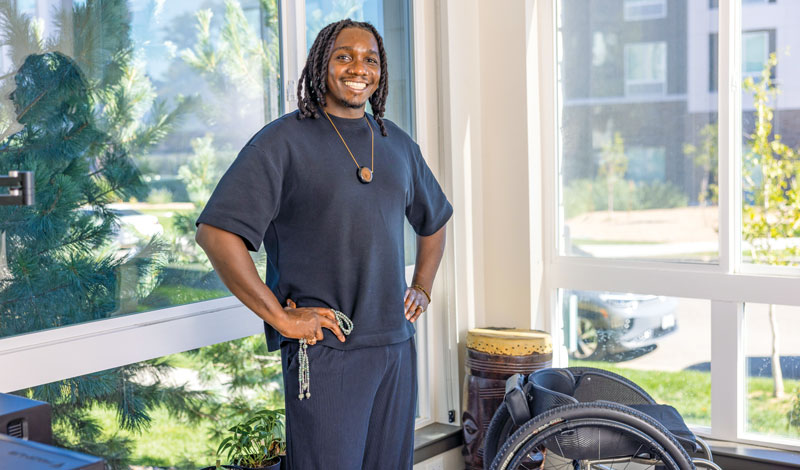
Living Buddhism: Thank you, Cory, for talking with us. Six years ago, on October 26, doctors informed you that you’d never walk again. Can you tell us what happened that day?
Cory Moses: Of course. It hit me while biking to my friend’s for lunch—this feeling as I turned down a skinny side street. Brace yourself, was what my gut told me, but scanning left to right, I saw nothing unusual. And then the driver-side door of the car parked beside me popped open, just wide enough to nick my handlebars and send me flying. I’d have been OK but for the SUV trailing too close behind me—the moment I wiped out, it ran over me, paralyzing me from the waist down. In the intensive care unit (ICU) with a fractured spine, six fractured ribs and my arm broken in two places, the doctors told me there was a very good chance I’d never walk again.
How did you process that?
Cory: Quickly, actually, which I know sounds odd, but I saw no point in dwelling on what couldn’t be changed. The hard thing for me was not what had happened but where I had ended up.
The ICU, you mean. It was…
Cory: Quiet. And … sad. Patients kept to their rooms. As I traveled the halls, the only sounds were muffled—televisions and an occasional cough. It was to drown out these sad, unfamiliar sounds that I reached out for the one sound that felt most familiar. Instinctively, upon waking, I began chanting Nam-myoho-renge-kyo, and kept it up for a long time.
By then, how long had you been practicing Buddhism?
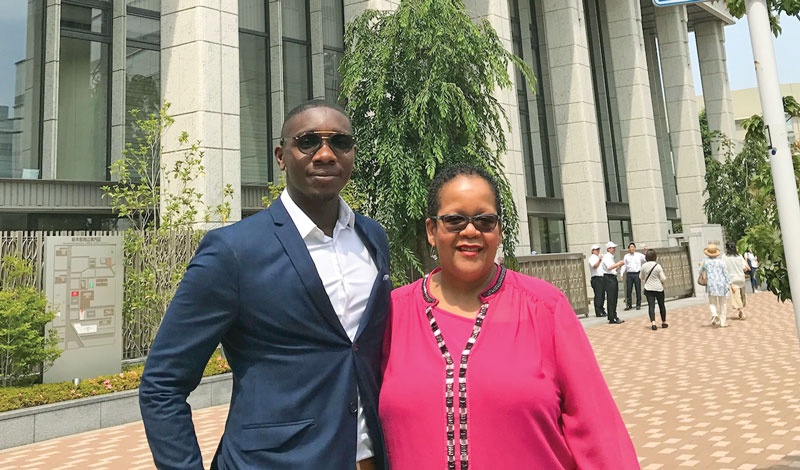
Cory: I had first heard the sound of daimoku when I was a child, every time we paid a visit to my aunt Joan in New York. Years later, I moved from Florida to New York to pursue my engineering degree. Throughout college, I lived with my aunt and every morning woke to the sound of her chanting. Now and again, I’d join in, noticing that it calmed and focused my mind—hugely helpful for me, wrestling my way through college with ADHD. She told me one day, when I’d been boxed in by homework and exams, how her Buddhist practice had been her sharp sword in her battle through med school. I trusted and respected her, so I took it up as well, becoming what you might call a “game time” chanter. At that point, I saw Buddhism as a means to an end—a tool to help me out of tight corners and get me where I wanted to go.
You wanted to become some kind of success.
Cory: An engineer and an entrepreneur. At 9, I’d sold all my video games to buy model rockets, dreaming of the day I’d take humankind to the far reaches of space and inspire countless people. Not until I crash landed in the ICU did I begin to focus less on where I wanted to go and more on transforming where I currently was.
In my bed at the ICU, I felt this subtle but constant pull toward defeat. For the first time, the crucial, paramount thing was the capacity to create joy where I sensed none.
When my aunt Joan came to see me, we talked about success—what it was, in essence. Success, she said, is just effort, right? Just the by-product of constant overcoming.
In this conversation and others that followed with her and the many members of my district who came to see me, I began to feel something I hadn’t expected, something resembling excitement. If there was ever a moment to find out what this practice could make possible, this really was that moment. Chanting in the days leading up to my discharge, I found myself imagining ever greater possibilities.
My next stop was the rehab clinic, where the focus was on acquiring basic life skills. I began learning how to safely get in and out of cars and how to cook meals from my chair. But chanting somehow brought my mind beyond preparing for everyday living—I found myself thinking bigger and bigger, until, before I knew it, I was imagining the impossible—imagining myself walking again.
After three weeks in the ICU, you were admitted to the rehab clinic—we understand that you entered with some flare.
Cory: You’re talking about the rocket pack, aren’t you—the one I mounted to my chair? I did do that—not a functional, fueled up engine, of course—just a design prototype I’d made in college. I did that a few weeks after entering rehab, after I’d begun making some friends. It was my way to signal to them that we could do more than get out of this clinic, more than merely get by. We were going places—this is what I wanted us all to believe—that we were going to live wonderful lives.
All my life, I’d wanted to inspire people. And all my life, I’d thought this would happen at some later date, when I’d become some massive success. But now, surrounded by those fighting to believe in themselves, it was clear to me that if I wanted to inspire others, I need not look any further.
Slowly—very slowly, bit by bit. One day, I’d discover that, with great effort, I could lift one knee half of an inch; another day I’d find I could do the same with the other. Eventually, the trainers saw fit to harness me above a specialized treadmill, which moved my legs, trying to remind my body what it felt like to walk. It was early in 2022 that I found I was able, by my own effort, to stand.
The way you talk about this is very matter of fact, but this was far from guaranteed. There are published articles about your recovery by national and local outlets. USA Today, for instance, ran a piece with the director of your rehab program, who said, “I’ve been doing this job for almost 30 years, and I’ve never met anybody like him. … He didn’t define himself by his limitations, but by his possibilities—at such an early stage in a traumatic injury, it was profound.”1
Cory: It’s true that many of my friends were battling hopelessness and depression—to be honest, so was I. It’s completely natural. But were we going to mope and hide from the world? That didn’t make sense to me—that wasn’t an option.
When we were released from our stays at the clinic, many of the friends I’d made there became shut-ins—ashamed and daunted by the thought of reintroducing themselves to the world as people with disabilities. I’d make my rounds and get us outside, into the neighborhood, for a stroll or a meal. Within months, I’d regained to a surprising extent my ability to stand and walk. Not only this, I was actually trying new things, discovering sides of myself I’d never known existed.
Such as?
Cory: Well, it turns out that I’m a very competitive person. Not at all evident before. Before the crash, a friend of mine had been nudging me to try fencing, which I had done but not with too much enthusiasm. When he came to see me in the hospital, I joked to keep things lighthearted, “Well, I guess there goes fencing.” He didn’t laugh but gave me a thoughtful look and then said: “Maybe. Maybe not.”
He introduced you to wheelchair fencing.
Cory: Para fencing, as it’s formally known. I got into it and found myself quickly competing and even, to my surprise, winning medals. It was not about beating somebody else, which was never a motive for me. This one-to-one sport felt like me versus myself, something with which I’d become increasingly familiar. The training, just like the battle, was about becoming better than who I was yesterday—a pursuit in which I’d come to find so much meaning. I began traveling the country to train and compete, most often to a state-of-the-art center in Denver. Throughout this time, I began to practice Buddhism in earnest—not just for myself but for others. And all the while, I regained my mobility, traveling by foot just as much as by chair.
Truly, you defied the odds. Later that year, you returned to work, mentoring high school coding and robotics students.
Cory: That was deeply rewarding work—those kids were so bright and so driven. They reminded me of why I’d fallen in love with engineering, the pure thrill of exploration and creativity. The jobs I landed in the years after this, while higher paying, were not as fulfilling. The workplaces were dreary and the work unengaging. But I brought into these spaces the lessons I’d learned through Buddhist practice. It wasn’t where I was that would determine my happiness but my own prayer and determination. I showed up every day with a smile, and in this way, I opened one door after another, toward work that increasingly fulfilled the qualities of the ideal job—of good, beauty and benefit.
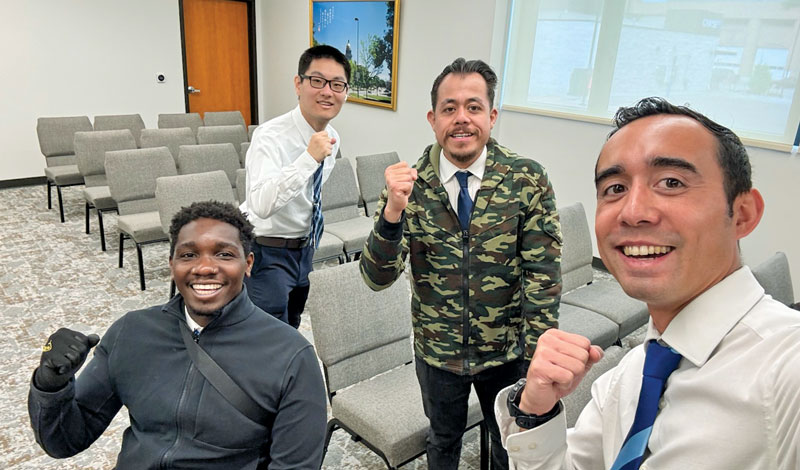
Two years ago, you moved from Brooklyn to Denver, where you continued to train as a fencer. Everything seems to have worked out just fine, but yours was quite a chaotic departure.
Cory: That’s true. In the spring of 2024, I was nearing the end of my lease. Thinking ahead, I entered New York’s housing lottery, which guarantees living spaces to a slate of New Yorkers at well below market rates. To my surprise, I won and immediately called in. But for a month, I was given the runaround. My calls were forwarded to one person after another, only to be put on hours-long holds. Then, just days before my lease was up, I was informed that all the housing had been taken. It was really frustrating to hear. But I sat down to chant with my brothers in faith and remembered that only I determine my happiness. I had to make a decision and make it fast—I decided to move to a place that had been growing on me, the place I’d been most often to train for fencing. That August, I packed my bags and moved to Denver, where I’ve been ever since.
What’s been your greatest battle these past two years?
Cory: For me, it wasn’t rebuilding community or succeeding in the world of fencing. Community was something I cultivated quickly, especially within the SGI. And fencing became more of a hobby—I got more into monoskiing, glass blowing and the arts. The hard thing for me was finding a job that I loved—I went through several that did not feel sustainable. One had a very long commute, another demanded very long hours. To each one, though, I brought my best self, praying morning and evening to uplift the people around me.
Increasingly, I grounded myself in my SGI community, even more than I ever had in New York. I took on leadership at the district level and began connecting with the guys. This helped me stay connected with a sense of mission to bring forth joy and hope. When, in February, I was offered the job that I wanted the most, but that I’d least expected to land, it felt organic—the result of all the causes I’d made—and I stepped into this new chapter with confidence. I did the same in September, when I was appointed a chapter young men’s leader.
I’m still passionate about innovative engineering—I’ve jump-started my own company designing AI-powered greenhouses. But ultimately, I’m focused on inspiring the people around me, simply by bringing forth here and now the very best of myself.
You are reading {{ meterCount }} of {{ meterMax }} free premium articles