

For many students, one of the hardest parts of college might not be the workload, but the feeling that everyone else is doing better than you. Scrolling through social media can instantly make us feel like we are behind in life.
But measuring our worth or achievements based on others can be a source of deep unhappiness. It can rob us of confidence, joy and purpose.
Ikeda Sensei explains: “You cannot be said to have true self-confidence if your opinion of yourself seesaws from high to low every time you compare yourself to others. A life spent judging yourself in terms of others will only end in frustration and deadlock” (Discussions on Youth, p. 292).
Buddhism teaches that every person possesses limitless potential. When we talk about a “Buddha,” we are referring to someone who has developed themselves to the greatest degree and has realized their limitless potential. Real confidence comes not from being “better” than others. It comes from developing an unshakable inner core born from striving hard to develop ourselves and achieve our goals, no matter how difficult or how many times we may fail. True growth and happiness begins when we stop measuring ourselves against others and focus on our own mission, values and progress.
For this reason, the most important comparison is not between ourselves and other people, but between who we are today and who we were yesterday. Have I grown? Have I challenged myself? Have I become stronger, kinder or wiser? This way of living leads to continual advancement and lasting happiness.
Sensei writes: “Do not compare yourselves to others. Be true to who you are, and continue to learn with all your might. Even if you are ridiculed, even if you suffer disappointments and setbacks, continue to advance and do not be defeated. If you have such a strong determination in your heart, you are already halfway to victory” (Victorious Teen, p. 8).
When discouraged by comparisons, we can remember these two points.
First, we are all Buddhas, without exception. That means each one of us are a Buddha of infinite worth! Sensei said it best when he wrote: “To think of oneself as just an ordinary person is indeed a great mistake. The fresh breeze of the Lotus Sutra dispels such dark clouds of illusion. It does not discriminate against the ordinary person but says that all people are themselves Buddhas, that the human being is supremely worthy of respect” (The Wisdom of the Lotus Sutra, vol. 5, p. 136).
Second, we each have our own unique mission and timing for growth. Just as flowers bloom differently, people reveal their potential at different times and in different ways.
Nichiren Daishonin said: “Each thing—the cherry, the plum, the peach, the damson—in its own entity, without undergoing any change, possesses the eternally endowed three bodies” (The Record of the Orally Transmitted Teachings, p. 200). Explaining this passage, Sensei says:
A cherry blossom can never become a peach blossom. Nor is there any need for it to try to do so. It would be perfectly miserable if it did. Similarly, you are none other than yourself. You can never be someone else, however much you might wish it. What matters is that you become the kind of person who can cherish, praise and feel content with your own precious, irreplaceable life.
Chanting Nam-myoho-renge-kyo is fundamental to this, enabling you to reveal your innate Buddhahood just as you are (The Wisdom for Creating Happiness and Peace, part 2, revised edition, p. 207).
Life is not a competition to outdo others. It is a journey to become the best version of ourselves. In Buddhism, this inner process of growth is called human revolution.
Our daily lives and our SGI activities, are the arenas where we carry out this human revolution. Chanting Nam-myoho-renge-kyo, encouraging others, supporting behind the scenes and participating in meetings are not just “activities,” they are opportunities to strengthen and transform our lives.
Sensei says:
As we push ourselves to successfully carry out one activity after another without being defeated, we forge our character and are able to win over our negative tendencies, thus doing our human revolution. Soka Gakkai activities are a kind of training ground on which to strengthen our being. It is by dedicating our lives to the mission of kosen-rufu and developing ourselves that we can transform our karma. (The New Human Revolution, vol. 16, revised edition, p. 12)
Being a student is the time when we build the foundation of our lives. It is a time to challenge ourselves, deepen our character and strive to become the kind of people we hope to be in the future.
So rather than being discouraged by comparisons, let’s continue advancing as the unique individuals we are and create a life that shines with our own irreplaceable value.
—Prepared by the SGI-USA Student Division
Digging Deeper

Name: Dhimaan Bhattacharya
City: East Lansing, Michigan
School: Michigan State University
Living Buddhism: Hi Dhimaan. Can you share how you started practicing Buddhism?
Dhimaan Bhattacharya: My parents began practicing Nichiren Buddhism in India in 2003, so I grew up with this Buddhist practice. When I was younger, I didn’t understand much and did it more to appease my parents.
I began practicing for myself in early 2023. I moved to the United States for college and struggled to make friends and connect with people. At the time I didn’t feel proud of who I was and wanted to become someone deeper.
I started studying Ikeda Sensei’s guidance and participating in the behind-the-scenes groups at the Detroit Buddhist Center. I realized the power of chanting Nam-myoho-
renge-kyo can enable me to transform my life inside and out.
What benefits have you experienced through your Buddhist practice?
Dhimaan: In 2025, I was struggling to find an internship, and to my core I grappled with self-worth about my own capabilities. I seriously chanted and studied Sensei’s writings to overcome these feelings. In his guidance, he often stressed the importance of sincerity. My determination transformed to be less fixated on an outcome and instead driven by passion and gratitude.
At the end of the spring semester that year, I received a call offering me an internship. This was actual proof of prayer, and in June I shared my victory at the Student Division Conference at the Florida Nature and Culture Center.
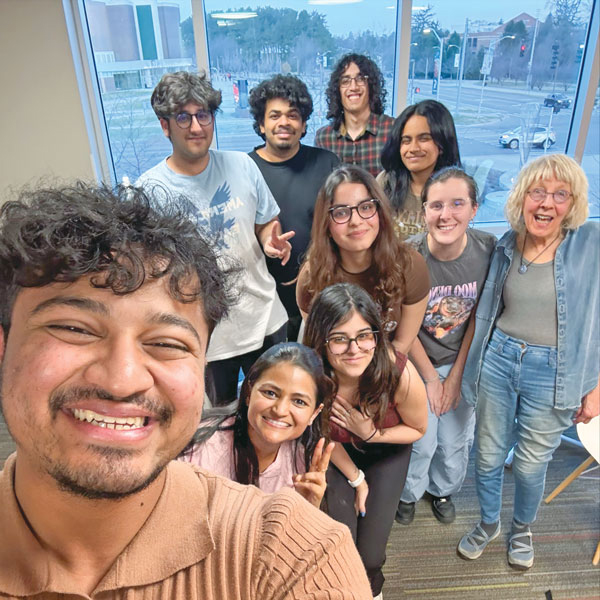
Experiencing this benefit, I felt a call to action to share Buddhism with others and vowed to create a campus club at my school.
That’s great! What was the process of starting a campus club at Michigan State University (MSU)?
Dhimaan: At first it was a struggle to find time to do it, and I was the only student really practicing Buddhism at MSU. After a senior in faith encouraged me to hold meetings, even if they were small, we began holding meetings and this gave me the courage to make our club official. That summer I submitted our club application and made it happen.
What are your club meetings like?
Dhimaan: In our club meetings, our aim is to facilitate dialogue rather than just having presentations. Students spend all day in classrooms listening to professors. Our meetings dig deeper through meaningful discussion.
I always have immense gratitude for how easy certain topics in Buddhism are to understand. In one of our meetings the dialogue centered around human revolution. Initially it was more superficial discussion, but gradually the discussion built substance. In the end, we saw how the concept can apply to our own day-to-day lives. Starting from basic Buddhist concepts always leads to fruitful discussion.
Have you experienced any challenges as a campus club leader?
Dhimaan: Yes. A big challenge was creating time for the club. Last fall, a lot of my time was occupied with looking for full-time work opportunities. I thought to myself, Let me get a job first, then I’ll do everything for the campus club. Things weren’t going my way and I realized that it’s the other way around. Making causes for the campus club and developing my Buddhist practice was how I could open up job opportunities. As I did that, I began getting interviews and connecting with more people in my field of interest.
I also challenged feeling uncertain about my efforts to build a campus club since I would be graduating soon. Through chanting, I decided that regardless, I was going to do my best to grow the campus club. Chanting this way also allowed me to believe in myself more.
Then another student who is an SGI member entered MSU. She will be leading the club from next year. Another friend of mine, who’s been coming out and is really interested in Buddhism, also said he’d be happy to run the campus club alongside her.
What is your determination now that you’ve graduated?
Dhimaan: Though I won’t be at MSU anymore, I’m chanting for the campus club to continue to grow. Personally, I want to eventually go back to school and pursue a Ph.D. in economics. Until then, I want to work in economic research and have a job where I can continue to fight for kosen-rufu. This way, I can develop into the best version of myself and support others to do the same.
You are reading {{ meterCount }} of {{ meterMax }} free premium articles