
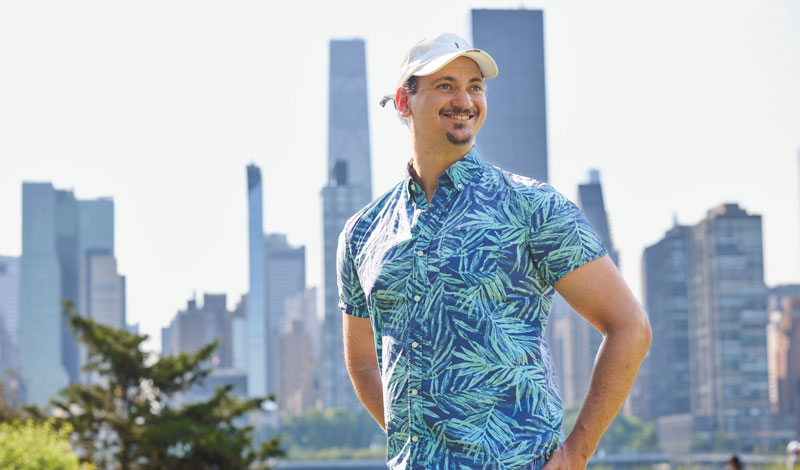
by Isaac Nikolic
Queens, N.Y.
It was inconceivable that my parents, together the past 30 years, were truly splitting up for good. It didn’t sink in the day my mom told me, or even when my father moved out. It didn’t click even as my dad fell into depression, drinking more than ever to cope. Not until his drinking cost him his job and he was forced to move in with relatives overseas, did I grasp what I’d been unable to grasp: All this was real, and I could do nothing to stop it.
Depression hit me in waves the following year, though I came up for air now and again. I managed that year to earn a master’s degree and even to maintain my health. But besides these two things, I had, in 2024, no hope at all. With no job, I felt stranded, like I’d missed the boat, like there was nothing left for me to do.
It was in winter that a friend told me she’d begun practicing Buddhism and in so doing had found a community that empowered her. I decided to go with her, mostly as a show of support, and was surprised by how positively affected I was by the people I met. It was, I think, my third meeting, at the start of last year, when someone asked me if I’d tried chanting Nam-myoho-renge-kyo as a daily practice. I hadn’t and was encouraged to give it a go, for a few minutes every day.
By the end of two weeks, I felt more focused and energized, less inclined to lose hours a day to scrolling. So, I kept it up, and I kept coming out, and for over a month, I felt great. For days at a time, I found I was able to live without dwelling on what I could not control.
And then, in May, chanting at my usual time, I ran up against a hugely uneasy feeling—a colossal doubt that ran down to my core. Instinctively, I shrank and did not dare chant again for fear I’d reencounter that feeling.
But I knew now there was something huge in my life that I could not ignore and at the same time live fully. If there was one place I could figure out what this meant, I knew it was at my discussion meeting that month. That was a place where people shared their struggles, where I wouldn’t feel afraid to reflect.
At the meeting, chanting with others, I summoned the courage to look again within, asking what it was that I was so afraid to see. I had no revelations, but left feeling stronger—strong enough to restart my daily practice.
Chanting in June, it hit me again—the doubt I did not understand. This time, though, I did not shrink away. I looked within without flinching. And there I found doubt the size of a mountain, that had been there all my life. Everything’s hopeless—this was the feeling, and it had grown enormous where my father was concerned. Believing otherwise, I realized, was too painful to bear; if I were wrong, the disappointment would crush me. But the more that I studied Nichiren Buddhism, the more I understood that if I did not believe that my father could recover someday, then I was denying both his potential and my own.
Many times, I broke down crying in front of the Gohonzon, realizing how much my life had been molded by doubt. I asked myself: Have I ever applied myself 100%? Or have I always felt it’s better to not give my all because then I don’t have to be afraid that I’ll fail? Have I ever let myself be vulnerable enough to take on a challenge I thought was impossible?
I began to move through these questions in earnest last summer, as I was supporting my district. Attending our planning meetings, we’d draft skits to perform, which made our meetings really fun. And I began searching in earnest for a job in my field, the environmental sciences. And I began to call and speak with my father.
At first, our conversations were painful for me—he didn’t feel there was anything left for him. But I told him, “I’m with people who are proving to me that there’s always something left. So whether you believe it or not, I believe that you still have life left to live.” On a practical level, I did understand that only he could determine his fate. But the more that I chanted, the more convinced I felt: I would win and so would my father.
At some point, we began to speak every day, and slowly I heard a change in him. Sometime in October, he admitted himself to rehab, and in December, I went to go see him. I was astonished by the person I saw—he looked great, having lost over 100 pounds. He was laughing, playing chess, making friends again—he was supporting others on their journey to sobriety.
I came back feeling enormously energized, more convinced than ever that I was the one who shaped my destiny and my happiness. What mattered more than even my circumstances was how I chose to respond to them.
This February, I drove down to Pennsylvania, a four-hour drive, to interview for a job I had a slim chance of getting. And quite literally, everything that could have gone wrong went wrong— my car died as I pulled up to the building. Rolling it effortfully into the lot, I then strode inside and knocked the interview out of the park. The car couldn’t be fixed, and I needed to stay overnight at a hotel nearby. My district’s planning meeting was that day, and I supported from afar, planning a fun and exciting activity. Whatever happened, I decided, I’m choosing to win, backing down from no obstacle in my path. I would have a great job, a great partner, a loving family—there could be no doubt, since I was putting in the work.
When in April I was offered an incredible job in environmental conservation here in Queens, I was, if I’m honest, pretty astonished; it’s extremely rare to be offered this role, with no internship, outright.
I’ve also begun dating a wonderful woman whom I cherish, something that felt impossible only last year. Everything, in fact, felt impossible then, but nothing does anymore. Whatever challenges arise, I know I will win, so long as I decide and take action.
You are reading {{ meterCount }} of {{ meterMax }} free premium articles