
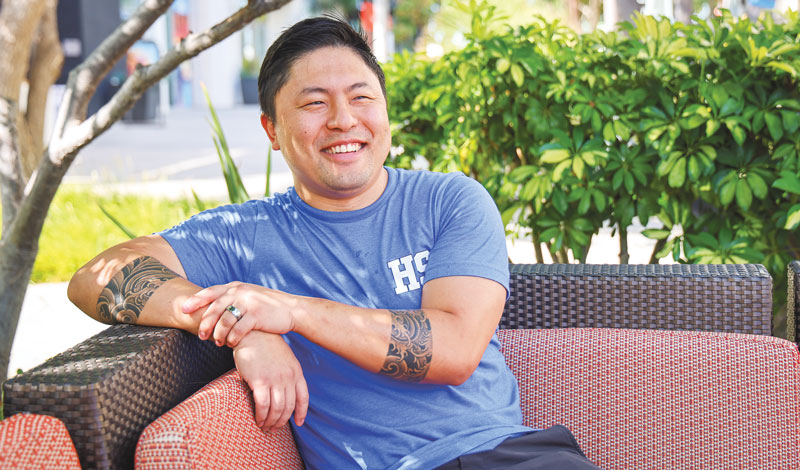
by David Honda
Torrance, Calif.
I knew from the start what some cadets overlook—that the police are the ultimate grunts. We were signing up to be the backstops of society, taking whatever was thrown at us, however hard it was thrown. Knowing this didn’t change what I knew of myself: I wanted to serve and protect people.
The night terrors began within my first year on the job, in the winter of 2018. The dead bodies, the overdoses, the extreme acts of violence—all took their toll, and not just on me. My senior officer, every day on the beat, vented his frustration at me. At the day’s end, I wasn’t sure what I’d learned, except how to numb myself to human suffering. I was, at this point, a Buddhist in name—I’d received the Gohonzon earlier that year. But I was brand new to the practice and didn’t really understand that I could use it to transform my life.
Traumas piled up and soon expressed themselves as symptoms—stress by day and panic attacks at night. Each day was the worst day of somebody’s life, and I was the one they’d called on for help.
In 2018, I broke down, resigned from the job and plunged into a deep
depression.
For nearly a week, I didn’t eat, hardly leaving my bed. I’d given up on what I’d dreamed of doing my whole life. Without that dream, I didn’t know who I was.
But on the fifth day, I got up and looked at my altar, which I hadn’t opened in days. I wondered if I had three Nam-myoho-renge-kyos in me. Palms together, I discovered I did. Then, I closed the altar and crawled back into bed. When I woke up, I felt just slightly better. I thought maybe I could eat some food. After a few days, I’d regained some strength, and noticed my most recent copy of Living Buddhism lying on a heap of unopened World Tribunes. Opening it onto a random page, I read this sentence from Ikeda Sensei—to this day, I know it by heart:
“The power of the Mystic Law enables us to decisively vanquish the darkness or ignorance that tries to diminish our supremely noble lives” (November 2018 Living Buddhism, p. 51).
In that moment, I was caught between two conflicting beliefs: That I could not escape the hell I was in, and yet that the statement I’d just read was true.
From then on, I dove into faith, wanting to engrave this belief in the depths of my life. My younger brother, seeing me climb out of depression, received the Gohonzon in March the following year. I accepted young men’s leadership, not knowing what that entailed, but knowing I wanted to help others believe in themselves. From these efforts came greater conviction and a determination to reenter law enforcement—this time, with a solid foundation.
That April, I was hired as a deputy sheriff, and journeyed for the second time into the field.
The three years that followed presented endless challenges that compelled me to deepen my faith. In 2020, I was posted at a maximum-security prison; later that year, I was deployed on major streets in full riot gear, as demonstrators hurled curses, bricks and live fireworks. In 2021, a friend on the force took his life, and I understood the pressures that had pushed him to do it. When I was paired that May with a harsh senior officer, I realized my career karma had come full circle. I was battling the same feelings I’d felt when I’d first become a police officer.
At this time, I reached out for guidance from my young men’s leader, who told me something that took me aback.
“Your job,” he said, “is not your actual job. Your true job is to be a Bodhisattva of the Earth. That means bringing forth your Buddha nature wherever you are, whatever job or position you’re in.”
Taking that to heart, I chanted about it, asking myself if I truly felt that being an officer was indispensable to my mission in life. Looking back on my five years of police work, I realized, for me, this path would come at the cost of my mental well-being.
Speaking with a psychologist, I weighed her feedback as well, and came slowly to the hardest decision of my life. I did not know, when I handed over my badge, whether I’d be crushed by a bout of depression. To my surprise, instead of guilt or shame, I felt a huge weight lift from my shoulders. Though I’d abandoned the only career path I’d ever known, I did not feel lost at all. I had my Buddhist practice and was determined to live with my faith as my map and compass.
That year, I supported many meetings behind the scenes, doing Soka Group at our local SGI centers. One woman said something that filled me with more pride than any compliment I’d ever been given in the field.
“You may not be a first responder by trade, but you’re a first responder for kosen-rufu.” She meant I was revealing my true self—my Bodhisattva identity—someone who lends hope and confidence to people.
Striving all-out as a young men’s leader meant I was constantly encouraging the guys to fight for their dreams. And this meant, of course, that I had to consider my own. Fighting on the frontlines of our movement, I began working for a nonprofit committed to peace. All these causes brought my own passions more clearly into view, and I realized what I cared about most. I wanted to bring people together, to help them feel cared for and safe. I also knew that I loved to cook. I realized I wanted to be a chef and someday run my own restaurant.
So, I began chanting for this, no longer confusing my job for my mission. My job was what I did 9-to-5; my mission was 24-7. Whether I was at work or an SGI center; whether I was home or meeting up with a friend, I saw each moment as an opportunity to challenge myself—as an arena to do my human revolution.
Beginning in November of 2024, my greatest battle unfolded at home. My grandpa, who had lived with me for years, began to show his age at 97. Without backing down from any of my responsibilities, my family and I took care of him.
It’s funny how this practice works—when you’re striving at your limit is when you really break through. At this time, I began working as a fulltime chef, which has brought me so much joy. I also began dating my wife—not an easy time to start dating. I just determined: If Mandy’s my person, we’ll pull through this stronger together. I had a similar prayer for our entire family: We’ll pull through stronger than ever. Mandy jumped right in to support, and between us all, we provided my grandpa with round-the-clock care.
My parents were moved by the way we stood by their side, and by how the SGI community stood by us all. Both received the Gohonzon this year in March, soon after my grandpa’s passing.
We’ve all grown stronger for what we’ve gone through, from doing the work that matters. I’ve decided to never stop doing that work—to always serve and protect. That’s my mission, and it can’t be taken away. Whatever I do, that’s who I will be.
You are reading {{ meterCount }} of {{ meterMax }} free premium articles