
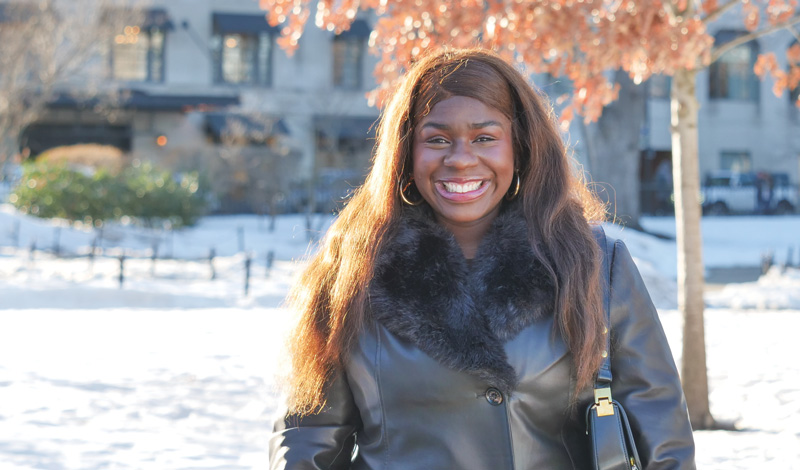
by Sasha Ndam
Boston
The news shook me to the core: 8th grader shot at the Dudley Street bus stop in an apparent act of gang violence. The anchorman reported this as matter-of-fact, the same way he might have the weather.
This isn’t happening! I wanted to scream, and also, That isn’t true! My friend had never been involved in a gang, only happened to live where gangs were active. For this he’d been shot while waiting for the school bus.
He’d been someone’s son, someone’s brother and my best friend, not some footnote of the evening news. Both the way his life ended and the way it was covered filled me with anger and fear. In both, I saw an indifference to the life of my precious and irreplaceable friend.
From the time I was young, I lived in two worlds—at least, that’s how it felt to me. In one, I felt cherished, loved and “enough”—that’s how I felt in the realm of the SGI. But outside of that, in the wider world, I compared myself constantly, struggling to see the beauty of my life.
Following my friend’s death, I spiraled. Calling the suicide hotline, I was admitted to a mental health facility, which I soon left, nearly as depressed as I’d come in.
My mother had been chanting fierce Daimoku with her friends in faith. Many came to visit when I came home. Among the first was our district women’s leader, who reminded me that she lived just three bus stops away and that I could come see her any time. Our lives were worlds apart, it seemed—a scientist more than double my age, she’d been born and raised in India. She was welcoming, though—you could even say, shining—but most importantly, I felt I could trust her. I began to stop at her place on my way to school, to talk with her and chant.
“Let’s visit our members,” she suggested one day, meaning the young women in our district. Many had come from abroad, and were pursuing their bachelor’s or master’s here, in the “university capital” of the country. But I don’t know what to say! I wanted to say, having so little in common with them. But I went all the same and discovered that each was struggling to overcome something. Often, we’d read something from The Writings of Nichiren Daishonin or by Ikeda Sensei and then chant to break through together. When we left, I felt better—every time—never once wishing I’d been somewhere else.
My first realization was that I did not then—nor ever did—truly want to take my own life. I was just sad—deeply, deeply sad. And while the grief could not be avoided, I was finding it could be transformed. Meeting with one person and then another, I was gaining conviction in the power of my life. Though I was so young and in such pain that I’d nearly flunked out of school, I discovered I could, nevertheless, encourage one person after another. I was learning that my life itself was Nam-myoho-renge-kyo, a conviction I carried with me into the following year.
Turning my grades around, I made honor roll, then the Dean’s list, then highest honors. Naturally, I began sharing Buddhism with neighbors, friends and family. In the course of the next decade, 11 of them received the Gohonzon, using the practice to tackle their problems and show actual proof.
This was my first encounter with death and grief, and prepared me, I think, for what may have crushed me otherwise. In 2013, of my sophomore year of college, my mother was diagnosed with lung cancer. This she dealt with the way she had every trial she ever faced—unafraid, marching to the beat of her own drum.
My mother was herself—a feat of courage for anyone, but especially, I think, for my mother. Her childhood memories were formed in Virginia, in the wake of Brown v. Board of Education. She was a child at the time of the Supreme Court decision, which ruled an end to the segregation of public schools. The decision was met with massive resistance, and she’d seen how brutal people can be—even to children. Years later, her siblings warned me against talking too freely with white people, warnings I might have taken to heart had not my mother raised me in the SGI, a community stressing each person’s humanity and their irreplaceable mission.
By 2019, it became clear that she was nearing the end of her life. Though not the first time I’d faced death, it was the first time I had to sit with it for so long, watching it draw nearer while knowing there was nothing I could do to stop it. Racked with fear, I began to study earnestly Sensei’s writings on the Buddhist view of life and death, chanting fiercely to grasp it with my life.
That year, I attended a youth training course in Japan, where I visited the Hall of the Great Vow. There, I chanted for my mother as intensely as I ever had about anything. As I did, I heard my mentor’s voice assuring me, simply: You have nothing to worry about, again and again. And I felt this with my whole heart.
My mother, I realized was something more than my mother—she’d lived a whole life before I’d come along. I began to chant for her, yes as her daughter, but also as something more—a comrade in life and death. I came home with a newfound calm and courage, and sat down with her to talk—not with worry, or pity, but as equals. And I discovered while we spoke something I’d missed in the fear eating me up until then. My mother, I realized, was not the least bit afraid of dying. The only fearful one was me.
When I returned, I poured my heart and soul into my studies, work and caring for her, focusing solely on making the most of each moment. She’d shown me how to live fully and true to herself—it was time I showed I understood.
In 2021, my mother took her last breath beside me, having prolonged her life years beyond her doctor’s predictions, deeply enjoying each day. And these were days that I also enjoyed, striving all out in a way that made her proud. Before she passed, she saw me enter the field of community engagement and enroll for my Master’s at DePaul.
It took time for me to recover from the pain of her loss, but now when I chant for her, I feel strong. Though she left behind few material things, she left me all that truly matters. She left me the memory of her courageous life—proof itself that the Gohonzon is all I need to be happy.
You are reading {{ meterCount }} of {{ meterMax }} free premium articles