
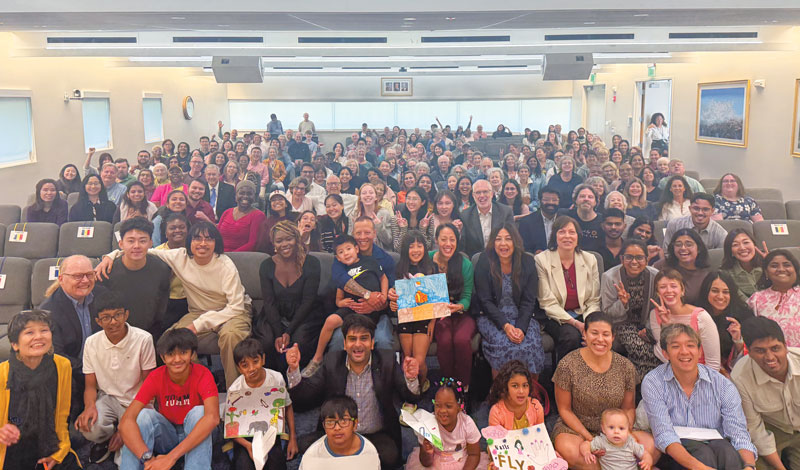

Boston—On the sunny morning of Sept. 12, 2026, members began arriving early at the New England Buddhist Center, reconnecting with old friends and sharing memories of Ikeda Sensei’s first visit to Boston. Some had traveled from as far as Buffalo, New York, while others came from across New England.
Thirty-five years earlier, in September 1991, Sensei arrived in Boston as he led the Soka Gakkai safely through the storm of attacks known as the second priesthood issue.[1] At Harvard University, he delivered his lecture, “The Age of Soft Power and Inner-Motivated Philosophy,”[2] emphasizing a turn from hard power to soft power and unleashing the inner energies of the individual. For the members supporting his visit at that time, Sensei’s concern for each person showed how such a humanistic philosophy could be put into action. Now a new generation is determined to carry that spirit forward. Led by North Zone’s young members, the commemorative gathering brought more than 200 people to the New England Buddhist Center, with another 150-plus joining via livestream. For them, the anniversary offered an opportunity to renew their vow and advance the “One Youth. Infinite Hope” campaign toward welcoming 10,000 youth to the SGI-USA by Jan. 2, 2028, Sensei’s 100th birthday.
Preparations began in August when the youth organizers formed committees, met regularly and studied Sensei’s poem “Flagbearers of a Human Renaissance,[3] dedicated to the Boston members. They drew particular encouragement from his words “You are kings and queens of the heart” and his call to “Bring forth a new Soka Renaissance / That shines with strong and dazzling splendor.” The planners wanted the gathering to embody that same spirit and inspire every participant to create victories in their own life.
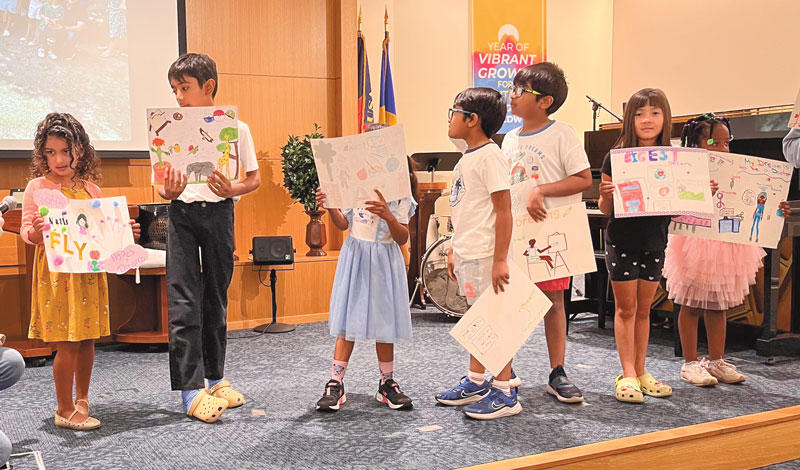
For organizer Dee Gopi, an important part of the gathering was connecting those who had personally met Sensei with younger people who know him only through his writings and the experiences of others. She was especially encouraged to hear newer members express a desire to deepen their relationship with Sensei and take action out of appreciation for his life and example.
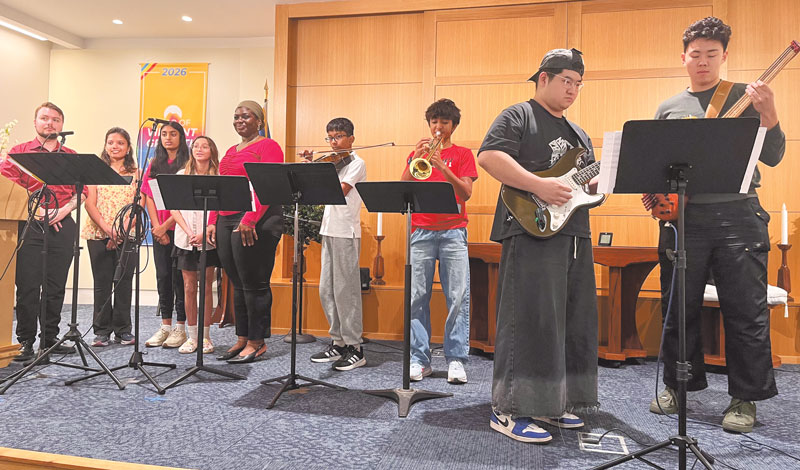
Men’s and women’s division members supported rehearsals and offered encouragement. Young people also invited friends to participate, including two guests who performed with the youth division’s band. Organizer Sumedh Kaul said their participation gave the two friends an opportunity to learn more about the SGI and Sensei.
On the morning of the meeting, the youth worked behind the scenes to ensure that every detail conveyed a welcoming spirit. Soka Group and Gajokai members arrived around 7 a.m., chanted together and checked the sound, video and stage arrangements.
Following daimoku and gongyo, the Ikeda Youth Ensemble opened the program with music that soon had the audience singing along. Future division members then carried posters displaying their dreams around the room, sharing aspirations that ranged from becoming teachers to surgeons. In a video presentation, young people from across the zone read passages from Sensei’s Boston poem.
The pioneer reflections brought participants back to 1991. Members remembered Sensei making time to encourage the drivers supporting his visit, leading calisthenics before his Harvard lecture and filling a meeting with laughter.
For Eddie Schaeffer, then a youth division member, Sensei’s joy left an unforgettable impression. “More than what Sensei said, it was his life condition that I will never forget,” he said.
Decades later, that memory continues to shape Schaeffer’s actions. Recently, he began visiting a young man weekly and sharing Buddhism with him. The young man received the Gohonzon in August and shared his experience at the commemorative meeting.
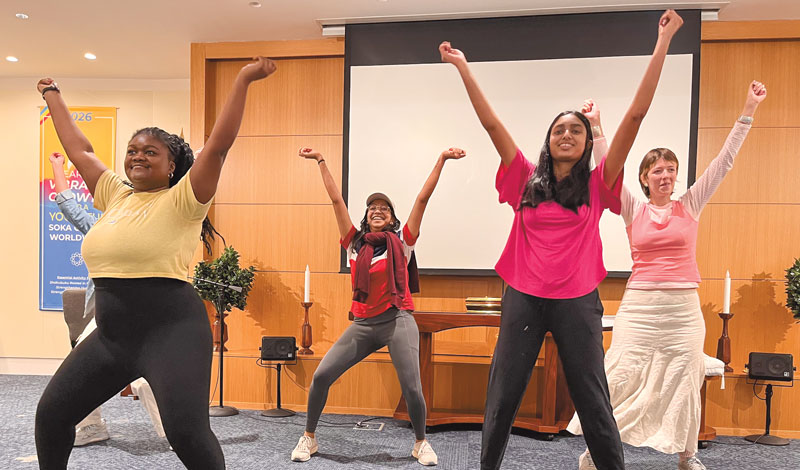
Making the Practice Their Own
The three new members who shared experiences described how practicing faith has helped them develop confidence, find community and support others.
Tanvi Kanade, who joined the SGI community on Aug. 2, recalled first learning to chant while facing a crisis as a teenager. Years later, after moving to Boston, she sought out the SGI and found a warm community. What changed, she said, was her own desire to practice.
“Nobody forced me. It came from within,” she said.
Today, chanting helps her feel grounded, understand herself and approach daily challenges with greater clarity.
Josh Frye, who also received the Gohonzon on Aug. 2, described finding support through the SGI while struggling with heartbreak. He shared how chanting and encouragement helped him move forward, find a job in Boston and build friendships. Now, he is chanting to find a home where he can host SGI gatherings to welcome guests.
“I feel truly blessed to encounter this community and practice,” he said.
Kunj Dave, a university student, spoke of how his goals grew after receiving the Gohonzon in February and attending a conference at the Florida Nature and Culture Center. While continuing to work through career uncertainty, he began reviewing classmates’ resumes and having more sincere conversations with friends. He has invited nearly 10 friends to district gatherings and youth activities. One conversation helped a classmate who had practiced Buddhism in India to reconnect with the SGI here in the United States. Through another encounter, he encouraged a friend struggling with loneliness in Madrid to meet with a local SGI leader.
“I simply spoke honestly about what had changed in my life and allowed each person to decide for themselves,” Dave said.
A Vision for the Future
In her closing words, Lori Karp, East Territory’s vice women’s leader, returned to the spirit behind Sensei’s Boston visits—awakening people to their own potential and encouraging them to win in their daily lives.
She recalled supporting Sensei’s second visit to Harvard in 1993. As a young woman, she was stationed at a table outside the room where he waited before his lecture. When he came out with economist John Kenneth Galbraith, he acknowledged Karp and the other young woman sitting next to her and immediately cracked a joke, making them both laugh.
The brief encounter left a lasting impression. Even before an important lecture, Karp said, Sensei took the opportunity to connect with and encourage those around him.
She shared his words: “Human revolution is meeting with people. Kosen-rufu is talking with people.”[4] “So, today we honor our past by having a vision for the future,” she said.
As the meeting concluded, each attendee received a postcard featuring a passage from “Flagbearers of a Human Renaissance” and a tracker for recording their efforts to share Buddhism—a way to carry the meeting’s encouragement into daily life.
Many lingered afterward, reconnecting with friends they had not seen in some time, sharing memories and discussing their determinations.
More than three decades after Sensei’s first Boston visit, North Zone’s youth had brought generations together around a shared resolve: to inherit his spirit not simply by remembering what happened in Boston, but by extending the same warmth and encouragement one person after another and opening the way for a new generation.
—Prepared by the World Tribune staff
October 9, 2026 World Tribune, pp. 6–7
References
- On Nov. 28, 1991, the Nichiren Shoshu priesthood excommunicated the Soka Gakkai. The Soka Gakkai rejected the priesthood’s claims of clerical superiority and absolute high-priest authority as distortions of Nichiren Buddhism. The date became known as Spiritual Independence Day, marking the Soka Gakkai’s liberation from priestly authoritarianism and a new era of worldwide kosen-rufu. ↩︎
- My Dear Friends in America, fourth edition, pp. 126–36. ↩︎
- Ibid., pp. 137–41. ↩︎
- Making the Impossible Possible, p. 60. ↩︎
You are reading {{ meterCount }} of {{ meterMax }} free premium articles