
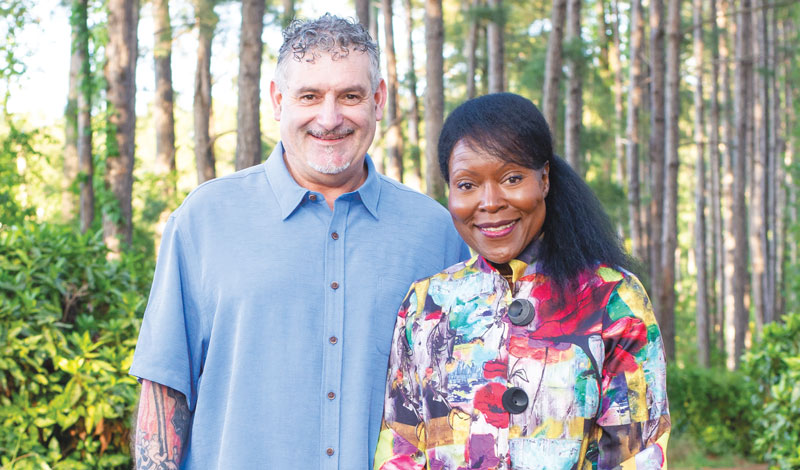
by Karon Anderson
Charleston, South Carolina
Of all the pastors my parents called over, Father Abernathy’s the only one I remember, the only one who didn’t threaten hell. He just listened to us—to my sister and me—and ended, simply: “Whatever you choose, the important thing is to become happy.” A refreshing and relieving opinion. We’d discovered and begun practicing Buddhism.
Our parents’ number one hope was that their daughters remain Christian, but a close second was that we’d one day become responsible. It was this second hope that they worried they might never see realized—we were spoiled, having always gotten whatever we asked.
So you can imagine their joy when we went off to college, a joy we kept alive as long as we could. And you can imagine their shock when they found out that we had secretly converted to Buddhism.
It was only with time that we won their confidence, by overcoming one challenge after the next. Graduating was one, landing a job was another. It helped that mine was a respectable job as a nuclear facilities technician.
But what I wanted most, that no one could give, was confidence in myself as a person. It was the members of the SGI women’s division who convinced me to believe—or at least try to believe—that I had a mission only I could fulfill. They told me their stories—of overcoming illness, of transforming extremely adverse circumstances, of creating harmony in seemingly impossible relationships. Out in the world on my own for the first time, I had only their encouragement to stand on. Chanting in front of the Gohonzon, I engraved Ikeda Sensei’s encouragement and began to do what my parents had always hoped I would: take responsibility for my life.
Through the example of the women’s division members, I came to grasp a fundamental truth: that great joy and growth are fueled by a spirit of contribution. “When you contribute for the sake of kosen-rufu,” they told me, “you are making a cause to deeply transform your karma.” It was with this understanding that I engaged from the very beginning in SGI’s May Commemorative Contribution activity.
They also said, “When you practice this Buddhism with all your heart, you’ll never go backward. Always, always forward.” In the years that followed, I’d hold fast to their words.
I was 34 when I realized that I was not fulfilled in my work and began chanting in earnest about my career. Over time, it dawned on me what I wanted to do: support those who needed it most. That prayer became more specific with time: to support those struggling with mental disabilities. Just when I began to pursue this in earnest—working as a mental health assistant while going to school—my prayer was put to the test.
In 2004, my marriage grew strained, then went up in smoke. I inherited thousands of dollars of debt and took a second job, as a janitor, to stay afloat.
The women’s division members lent me their ears and shoulders, but never once their pity. As they had from the early days of my practice, they encouraged me to take responsibility for my life—to seize difficulty as an opportunity to dramatically transform my karma and open the path of my mission. The fastest way to become happy, they said, was to work for the happiness of ourselves and others. On my days off, I’d go with them to talk, chant and study with others—some who were struggling even more than I. During this time, I engaged as ever in the May Contribution campaign, even when I had just a little to give. As Sensei explains, contribution is purely about our determination and our spirit. It was in the spirit of contribution, I truly believe, that I found the way to transform my circumstances.
A tendency in my life that I began to clearly perceive was one that had lingered in my life a long time. It was a tendency, I realized, to blame and complain.
But Buddhism teaches that no one but I can transform my karma. Scrubbing toilets late at night after a full day of assistant work, I began to experience something I did not expect, that felt at first out of place. Nonetheless, there it was, unmistakably: appreciation. I was growing, becoming a person of true strength and character.
Coming home late at night, I’d wonder how on earth I’d make myself do the schoolwork needed to earn my master’s. Before doubt could set in, however, I sat in front of the Gohonzon, chanting Nam-myoho-renge-kyo. A fighting spirit rose up in me then, and afterward, I’d tackle my homework with a focus I didn’t know I had. In 2005, I earned my degree, after which I was immediately promoted at work.
And then, in 2012, when I thought I’d laid a truly firm foundation in faith, shocking news rocked me to the core. I had cancer, my doctors told me. They recommended a full hysterectomy. I chose to get the surgery, but my faith was completely shaken. I stopped chanting and would not accept calls or visits from members. This continued for about four months. It was not until April of the following year that I decided to join an activity. A busload of members was heading from Charleston to attend the groundbreaking ceremony of the Atlanta Buddhist Center. I got on that bus and reconnected with friends I hadn’t seen in a while, who reminded me of what for months had been missing from my life.
I deepened my Buddhist study and saw my diagnosis with new eyes, from the profound perspective of faith. My illness was no defeat but rather, if I chose, a catalyst for growth. Again, my friends in faith pointed me toward the path of greatest value, which lies in working, even in hardship, with the spirit to contribute to kosen-rufu. In 2015, I got licensed by the state and felt truly prepared to contribute with all my heart to my clients.
In 2015, I traveled to the Hall of the Great Vow in Japan and brought with me a prayer to meet my life partner. The following spring, I met Joe, who today is my husband and best friend.
In 2021, I accepted a full-time counseling position, a role that brings me in contact with children for most of my day. And earlier this year, I launched a coaching program for parents with autistic children. The work is hard—as all rewarding things are—but truly, truly enjoyable. What I want parents and children alike to know is what I have been fortunate to learn through faith: that the most important thing is to become happy, and that happiness is found in a contributive life. This is the way to always move forward, turning all difficulties into opportunities to grow.
You are reading {{ meterCount }} of {{ meterMax }} free premium articles