
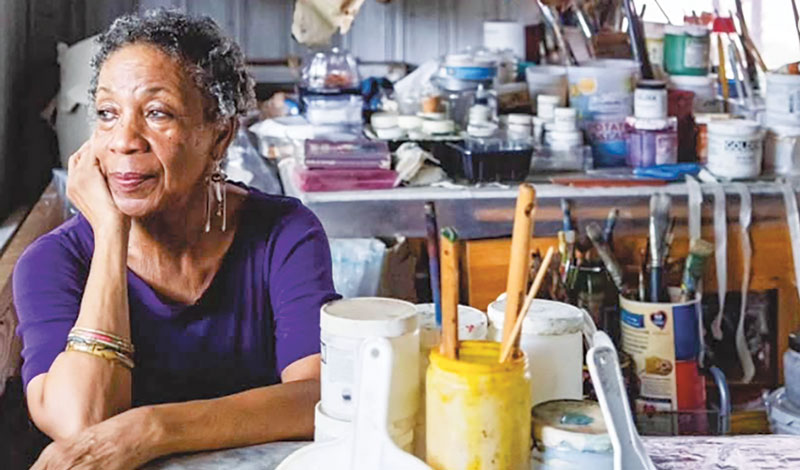
Through a dynamic mix of painting, sculpture and mixed media, abstract art comes to life with cultural storytelling and community activism in Suzanne Fitzallen Jackson’s work.
She was born in 1944 in St. Louis and in 1952, moved with her family to Alaska. At 16, she became the first African American girl selected to attend the National 4-H Congress. This opportunity opened the door to scholarships that supported her artistic development. She later received recognition and earned the World Peace, Humane Society and Kindness to Animals scholarships. These early honors became important steppingstones on her path to becoming a sculptor known for creating work centered on peace and compassion.
At the beginning of her career as an artist, she also became a teacher at Saint Stephen’s School in California and helped establish art galleries on campus. At 24, she was inspired by her art mentor, Charles White, who showed her that art was not only for aesthetic enjoyment but was a tool for sharing ideas and philosophies and for fostering community activism. Motivated by this vision, she established Gallery 32, which opened for two years and became a space to showcase socially engaged work.
Jackson experimented with layering watercolor and acrylic and worked in mixed media and sculpture, creating three-dimensional pieces that focused on cultural storytelling and community. On the cover, the ‘white eyes’ shift (2022) is created using layered acrylic. Her artwork features layers of various materials, including acrylic, feathers, wood, mesh and more. Through layered and mixed materials, she creates three-dimensional work that emphasizes texture and depth. Her work also draws on her studies in theatre design. Her art serves as a complex, layered reflection of community and her personal identity, and it led to her national recognition when she won the Helen Frankenthaler Award for Painting in 2024.
Through Jackson’s abstract, layered artworks, she transforms the materials into stories of community and culture. Her work demonstrates how art can serve as a force for peace and connection, bringing communities together and fostering understanding through shared stories.
—Prepared by the World Tribune staff
You are reading {{ meterCount }} of {{ meterMax }} free premium articles