

SGI General Director Yoshiki Tanigawa said the following in a guidance session with the SGI-USA Executive Council and Central Executive Committee on Sept. 13, 2025, during the CEC’s third quarterly conference of the year. (See pp. 6–7 for a CEC report.)
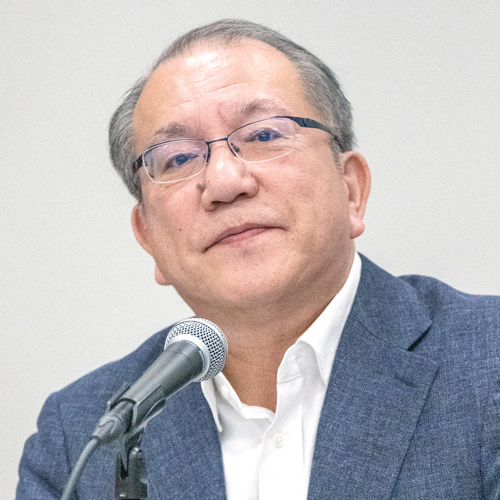
by Yoshiki Tanigawa
SGI Vice President
Recently, the SGI-USA Executive Council unanimously renewed Adin Strauss’ [third] term as general director. I’m celebrating this fresh start with you all!
Over these next three years, I will be chanting for, looking forward to and wholeheartedly supporting the continued success of your activities, which are certain to contribute to the further development of the SGI-USA.
Today, you discussed how to steadily progress in advancing your activity guidelines of “shakubuku rooted in friendship,” “strengthening our youth” and “strengthening our district community.”
Both during the time of second Soka Gakkai President Josei Toda and Ikeda Sensei, there were moments when the momentum of shakubuku would suddenly take off. What caused this shift in momentum was when there was a focus on consistent discussion with small groups of people.
A scene in The Human Revolution, “Future Perspectives” chapter, describes August 1956, a time when the Soka Gakkai had grown to the extent to be able to field its first candidates in a national election. At that time, Mr. Toda reflected on his days of developing the organization after the war. Sensei writes:
During the reconstruction period, Toda had attended discussion meetings almost every night—gatherings of only small numbers of people. The leaders would accompany Toda to such meetings where they would learn in detail how to propagate Nichiren Buddhism and what it was to give guidance. Oh, how lively and happy those meetings had been!
Nothing makes a person grow further than engaging in actual practice. The smaller the meeting, and the more free of formality and the more openhearted it is, the closer is the contact into which the people’s lives come. This closeness serves as the axis around which firm solidarity forms, friends are made, camaraderie builds up and the Gakkai spirit vibrates. Faith, this invisible quality, manifests itself in animated discussion meetings in which the participants’ hearts fuse in perfect harmony. (pp. 1489–90)
And, in 1961, after Sensei had achieved the propagation milestone of 2 million households, he discusses how to carry out the next phase of expansion:
The purpose of sharing the Daishonin’s teachings was not simply to increase the membership but to enable all people to become happy. It was vital, then, that as the membership increased more care and attention be focused on each individual. Guidance and encouragement had to be given to deepen the members’ understanding of Buddhism and allow them to advance in faith with courage and joy.
The discussion meeting was the place where this human contact took place. Such meetings held at the most basic level of the Gakkai organization—at the unit level—would be an oasis of dialogue and human interaction. (The New Human Revolution, vol. 4, revised edition, pp. 202–03)
He continues:
At this time, the average unit consisted of about a dozen households and provided an intimate setting for discussion. Precisely because unit meetings were small, people felt free to ask questions. Such small gatherings were flexible and informal, making it possible to focus on the needs of any new members who might be there. As the sphere of happiness within each unit expanded and the members’ conviction in faith grew, the solid grassroots base of the Soka Gakkai developed even further. (NHR-4, revised edition, 202–03)
This guidance reflects going beyond looking at the size or organizational level that a discussion meeting is held. They teach the importance of holding activities and meetings where people can take part in small-group discussions, leaving completely satisfied from their engaging conversations.
The key to “strengthening our district community” and vibrant growth and advancement will be creating many opportunities for enriching small-group discussions.
In addition, one other vital point for increasing the momentum of growth and expansion is pulling forth and giving full play to the power of the youth.
In The New Human Revolution, vol. 4, Sensei continues:
Essential to the success of each discussion meeting were the efforts not only of the leaders but of the core members in inspiring and encouraging all who attended. That was the main reason why Shin’ichi had asked the young men and young women to involve themselves actively in discussion meetings. He held boundless hopes for what they could contribute, since they had demonstrated remarkable growth in such a short time. He looked to the youth to bring the vital pulse of kosen-rufu to every corner of the very forefront of the Gakkai organization. (NHR-4, revised edition, p. 203)
He also writes:
The radiant faces of youth inspire hope; their passionate words awaken courage in people’s hearts.
If young people were confined to displaying their potential only within the youth division, they could not become a true driving force for the times. Their training in the youth division was significant precisely because it enabled them to lead and inspire members of all generations. Youth represent the light that leads us to a hope-filled future. (NHR-4, revised edition, 203)
Fresh, new hope for the future is found where young people can fully demonstrate their power and capability.
Sensei always emphasized this unchanging guideline for the 21st century—that “the United States is the center of the worldwide kosen-rufu movement in the 21st century.”
In the U.S., with clear and mounting divisiveness increasingly impacting society, what is vital for creating the next wave in advancing kosen-rufu in this country is for all the leaders, with Adin in the lead, to return to and thoroughly challenge yourselves in the fundamentals of home visits and personal guidance. Sensei said:
“It’s crucial that leaders take every opportunity to visit members and encourage them. We must push ourselves to visit even one more family and continue to offer personal guidance to as many people as we possibly can.
“That is the way to help our members become happy, to strengthen the organization and to build a strong foundation for the Soka Gakkai. It’s a mistake to think that there’s some other special way to do so.
“To grow crops, you need to carefully till the soil with a plow or hoe. To foster capable individuals, you also have to nurture their growth through continued patient efforts to offer personal guidance.” (NHR-27, 193–94)
In addition, he says the following in his Columbia University address:
What then, are the conditions for global citizenship?… Certainly, global citizenship is not determined merely by the number of languages one speaks or the number of countries to which one has traveled. I have many friends who could be considered quite ordinary citizens but who possess an inner nobility; who have never traveled beyond their native place, yet who are genuinely concerned for the peace and prosperity of the world. (My Dear Friends in America, fourth edition, p. 450)
The quintessential way to polish our abilities to be effective global citizens who can help break through existing global threats is to thoroughly and steadily engage in home visits and personal guidance.
With Adin leading the charge as general director and taking action based on this ideal, I ask all of you, the top leaders of this organization, to initiate a fresh battle to shine a light on every member, have heartfelt conversations with them and encourage one another so everyone can be enveloped in benefit and fortune. Let’s expand the network of people who are overflowing with joy and vitality so that fresh new winds of change blow throughout every corner of the SGI-USA!
You are reading {{ meterCount }} of {{ meterMax }} free premium articles