
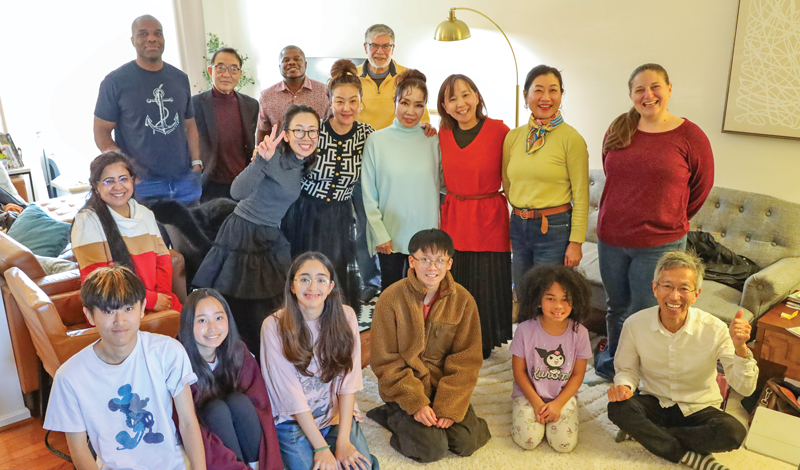
Please present the 3-minute Gosho (pp. 40–41) at your discussion meetings. For the main study portion of the meeting, you can choose to expand on the 3-minute Gosho or choose from one of the following:
1) What Do You Think? (pp. 42–43)
2) Material from any recent issue of the World Tribune or Living Buddhism.
3 Minutes Gosho
This series can serve as the basis for a brief study presentation at monthly discussion meetings, to be given by future, student or youth division members (or by other members if youth are not available). Those presenting can simply read the material or get creative!
‘Like Roaring Lions’
Passage
“Each of you should summon up the courage of a lion king and never succumb to threats from anyone. The lion king fears no other beast, nor do its cubs. Slanderers are like barking foxes, but Nichiren’s followers are like roaring lions.” —“On Persecutions Befalling the Sage,” The Writings of Nichiren Daishonin, vol. 1, p. 997
Background
Nichiren Daishonin wrote “On Persecutions Befalling the Sage” on October 1, 1279, addressing all his disciples. Beginning around 1275, harassment of Nichiren’s disciples in the Atsuhara area worsened to the point that 20 believers were falsely charged and arrested. Yet, none renounced their faith. Inspired by their courage, Nichiren realized he had fulfilled his purpose—establishing a Buddhist practice that could be upheld by ordinary people. In this letter, he urges followers to persevere with the fearless spirit of a lion king.
From Ikeda Sensei’s The New Human Revolution
Courage: The Cause for Victory in Life
Ikeda Sensei (who appears in the novel as Shin’ichi Yamamoto) addresses a gathering of youth.
“In Buddhism, the Buddha is described as a lion, and his preaching of the Law as the ‘lion’s roar.’ Nichiren Daishonin taught that the word ‘lion’ has the significance of ‘mentor and disciple.’ The Lotus Sutra teaches that disciples—that is, living beings—who live out their lives together with the Buddha, their mentor, can attain the same elevated life state as the Buddha.”…
Quoting the Daishonin’s call “Each of you should summon up the courage of a lion king and never succumb to threats from anyone” (“On Persecutions Befalling the Sage,” WND-1, 997), Shin’ichi also emphasized that the “heart of a lion king” is courage.
He said: “We all possess courage. Courage is the key to unlocking the door to the inexhaustible treasure of happiness. Many people, however, have sealed that door and remain adrift upon a sea of cowardice, weakness and indecision. I hope that you will all summon up great courage and vanquish every trace of cowardice in your hearts. That is the cause for victory in life.” (The New Human Revolution, vol. 30, pp. 811–12)
Presenting this month’s 3-minute Gosho?
Click here for a brief tutorial video.

What Do You Think?
What Does ‘Hope’ Look Like For You?
A new study shows that watching just a few minutes of inspiring content each day can help us feel more hopeful.[1] That’s a refreshing counterpoint to what we often hear about how endless online scrolling can leave us stressed, overwhelmed or drained.[2]
In this new study of 1,000 U.S. adults (ages 18–86), participants were placed into four groups. For five days, each group was tasked with either watching inspiring videos, watching comedy, practicing meditation or doing nothing at all (the control group).
Interestingly, the group that watched comedy didn’t experience a boost in their hope levels. But those who watched brief doses of inspiring content seemed to have a greater sense of hope, as did those who meditated.
These findings seem to align with our Buddhist practice of chanting Nam-myoho-renge-kyo and sharing faith experiences at SGI meetings. Our meetings are often filled with stories of members overcoming hardships and winning against the odds.
Nichiren Daishonin taught that our “voice does the Buddha’s work”[3] in leading people to enlightenment. By extension, Ikeda Sensei says, “Since we attain the Way through the sense of hearing, it is vital that we speak, that we use our voices.”[4]
Sharing our personal accounts of how chanting helps us enact meaningful change in our lives connects people to the “rhythm of hope”[5] found in our Buddhist practice.
What Is Hope?
Hope can be described as the feeling of “yearning for relief from a negative situation, or for the realization of a positive outcome when the odds do not greatly favor it.”[6]
What does hope look like for you? Have you ever felt that it was out of reach?
In Nichiren Buddhism, hope isn’t the same as wishful thinking. It’s not determined by anything outside of us. We consciously choose to create hope for ourselves.
Even if something or someone momentarily uplifts our spirits, Sensei reminds us that “hope is a flame that we nurture within our hearts.”[7] It takes courage to keep that flame alive, especially when life feels uncertain. Sensei adds:
Real hope is found in committing ourselves to vast goals and dreams—dreams such as a world without war and violence, a world where everyone can live in dignity.
The problems that face our world are daunting in their depth and complexity. Sometimes, it may be hard to see where—or how—to begin. But we cannot be paralyzed by despair. We must each take action toward the goals we have set and in which we believe. Rather than passively accepting things as they are, we must embark on the challenge of creating a new reality. It is in this effort that true, undying hope is to be found.[8]
Every time we study Buddhism and chant Nam-myoho-renge-kyo to the Gohonzon, we can renew our determination to elevate our perspective and act with wisdom and courage. We can strive to become living examples of what Sensei calls “dealers in hope,”[9] igniting hope in ourselves and others in any place, at any time.
—Prepared by the SGI-USA Study Department
From the January Living Buddhism
References
- “Got 3 minutes? This habit may help boost hope and reduce stress,” https://www.npr.org/2025/10/27/nx-s1-5575251/social-media-hope-stress-mental-health<accessed on October 31, 2025>. ↩︎
- See https://www.apa.org/monitor/2022/11/strain-media-overload <accessed on Nov. 3, 2025>. ↩︎
- The Wisdom of the Lotus Sutra, vol. 5, p. 76. ↩︎
- See The Record of the Orally Transmitted Teachings, p. 4. ↩︎
- See WLS-5, 73. ↩︎
- See https://www.apa.org/pubs/journals/releases/ppm-ppm
0000623.pdf <accessed on November 3, 2025>. ↩︎ - Hope Is a Decision, p. 5. ↩︎
- Ibid., 7. ↩︎
- See The World of Nichiren Daishonin’s Writings, vol. 1, p. 146. ↩︎
You are reading {{ meterCount }} of {{ meterMax }} free premium articles