
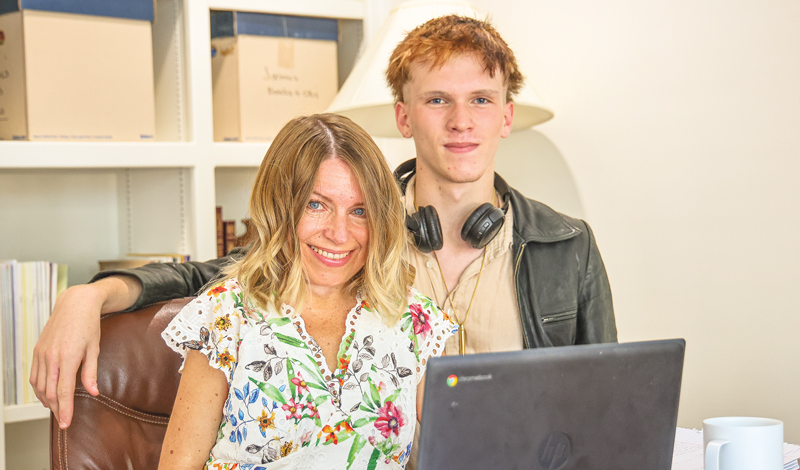
by Joanne Hash
Whittier, Calif.
What was prized on the ranch was strength—the kind needed to build fences, buck hay and irrigate the land.And while I made the most of sheer stubbornness—shelling peas, bottle-feeding calves and steering the feed truck while my brother worked the pedals—there were many jobs I simply could not do; my condition put them out of reach.
At 2 years old, I was diagnosed with severe juvenile rheumatoid arthritis, a painful, chronic condition that deforms joints and hinders movement.
Despite everything, I was happy—I loved our Idaho ranch, with its friends, family and animals and would not have left it for the world were it not for the hopes of my parents. When I was 6, they sat me down and told me I’d be going away. They’d heard of a physical rehab program out of state that promised greater range of motion, strength and freedom to the children it served. That year, I went and was returned with a broken femur, in a body cast, traumatized and falling into a debilitating depression.
The lesson, engraved in my body and mind, was that the world for me was dangerous. Dangerous and, also, I’d later learn, uninterested. Come high school, my grandmother, scanning a pizza parlor peopled by young couples, turned to my father and sighed: “Aren’t you glad Joanne’s not normal?” Glad because he need not worry about boys. Come college, I’d hear in passing: “Pretty for a disabled girl.”
Stubbornly, I refused to be bothered—I’d decide the life I’d live. And yet, when confronted by a real challenge—I shied away.
The college I wanted to attend was nine hours north of my family home. Instead, I attended the local one. When a professor nominated me to represent our school at an academic competition, I agreed, then backed out days before, feeling daunted and unreasonably afraid. I’d dance this dance many times—approaching and then avoiding my opportunities. Deep down, I did not believe I had the strength to live fully.
This began to change my junior year, when I made a friend in biology class. She invited me to an SGI meeting and, curious about Buddhism, I went.
I was not prepared for what I found—to feel not only welcome but embraced. It was clear that everyone there truly cared about one another. I loved the chanting of Nam-myoho-renge-kyo and the philosophy it expressed—of the interconnectedness of all life and its inherent dignity and unlimited potential. My scientific mind loved that I was invited to put the practice to the test.
I began chanting every morning and reading from a gifted book of daily guidance. Each page resonated with my entire being, distilling what I’d always believed—or rather, what I’d always wanted to believe. In chanting, I was engraining these beliefs into my heart.
By this time, I had my sights set on a Ph.D. program in Behavioral Neuroscience, so it is perhaps only natural that the following guidance struck a nerve—it has been my guidepost ever since:
When we change our inner determination, everything begins to move in a new direction. The moment we make a powerful resolve, every nerve and fiber of our being will immediately begin to orient itself toward the fulfillment of this goal or desire. (Hope Is a Decision, p. 3)
Fueled by this resolve, I did what I only dreamed of doing before—I left my hometown and flew across the country, to New Jersey, where I knew not a soul, to attend Rutgers University. Immediately, I connected with the local SGI community—and with my chapter women’s leader, in particular, who made it her mission to ensure I had a thorough grasp of Buddhist principles.
One that blew my mind was that of “voluntarily assuming the appropriate karma.” According to this principle, our lives are manifestations of a vow we ourselves have made in the infinite past. According to this principle, I was no victim but, in fact, exceptionally strong—someone who intentionally chose her circumstances in order to demonstrate that they could be overcome. Engraving this concept in my life sparked a seismic shift in my relationship with myself, one that paved the way for extraordinary benefits—among them, meeting the man who’d become my husband and giving birth to our son, Jet, in 2009.
This would not have been possible without this Buddhism, which I’d have never found were it not for Ikeda Sensei.
I gave birth to Jet the following winter—the easiest, most delightful pregnancy you could hope for—and soon after moved to Whittier for my dream job at a small liberal arts college.
When the pandemic hit, school went online and we moved, in 2020, to rural Idaho to weather the storm. When restrictions eased, we moved to southern California, but not to Whittier. We moved to Lake Arrowhead, about 90 minutes east where everything I’d once appreciated as a beautiful benefit became a tremendous obstacle.
The commute proved far longer with traffic than expected and took a major toll. At home, disharmony wore on us all—my son, in particular—and reached a point of crisis in September 2023, when a routine check-up showed twin tumors on my hips, flagged by my doctor as a potential indication of stage 4 bone cancer—a terminal diagnosis.
This was to be a two-month ordeal, throughout which my prayer was a desperate one: I have to be healthy for my son.
The day before my doctor’s appointment, the one that would confirm or rule out the cancer, I received the news that Sensei had passed away. The following morning, I chanted and understood something deeply: My mentor needs me now more than ever to fight for kosen-rufu in his stead. As his disciple, I have to be well. I will be well. With this understanding, my prayer filled me with new strength. And then I went in for my check-up. The tumors turned out to be benign, the result of a long-ago joint replacement surgery.
The following summer, I again had a major health scare, diagnosed with a life-threatening autoimmune condition. While the condition stabilized with medication, it was unclear whether I’d ever fully recover my health. I chanted fighting daimoku and vowed to overcome this challenge that I myself had chosen, to show great proof of the power of this practice. Still, I was taken aback when, that fall, I was given the opportunity to take on women’s leadership for La Puente Region. For a moment, I wanted to shy away, but after chanting, realized this was my opportunity to show great proof and transform my karma. I accepted and continued to fight all-out.
I continued to monitor my health and discovered, to my doctor’s astonishment as well as my own, that my blood work, for the first time in decades, presents as perfectly healthy—all levels within the normal range. Furthermore, I applied and received a position that enabled me to move onto campus, a move I’d long thought impossible due to the living quarters, built inaccessibly atop flights of stairs. But I applied nonetheless and they have made it work! Today, my roundtrip commute has gone from five hours by car to five minutes on foot. Jet is thriving, taking college-level classes and courses in violin. As an educator, a mother, a women’s leader and a disciple of Sensei, I feel it is my mission to reveal to everyone the unlimited power within their own lives—to go from strength to strength to strength.
You are reading {{ meterCount }} of {{ meterMax }} free premium articles